The ‘Open Sesame’ Secret: Keeping Your Garage Door Opener Happy
Your Garage Door Opener Works Hard Every Day — Here’s What It Needs
Yes, garage door openers do need to be serviced — and more regularly than most homeowners realize.
Here’s the quick answer:
| Maintenance Task | How Often |
|---|---|
| Professional tune-up | Once a year (or every 3,000 cycles) |
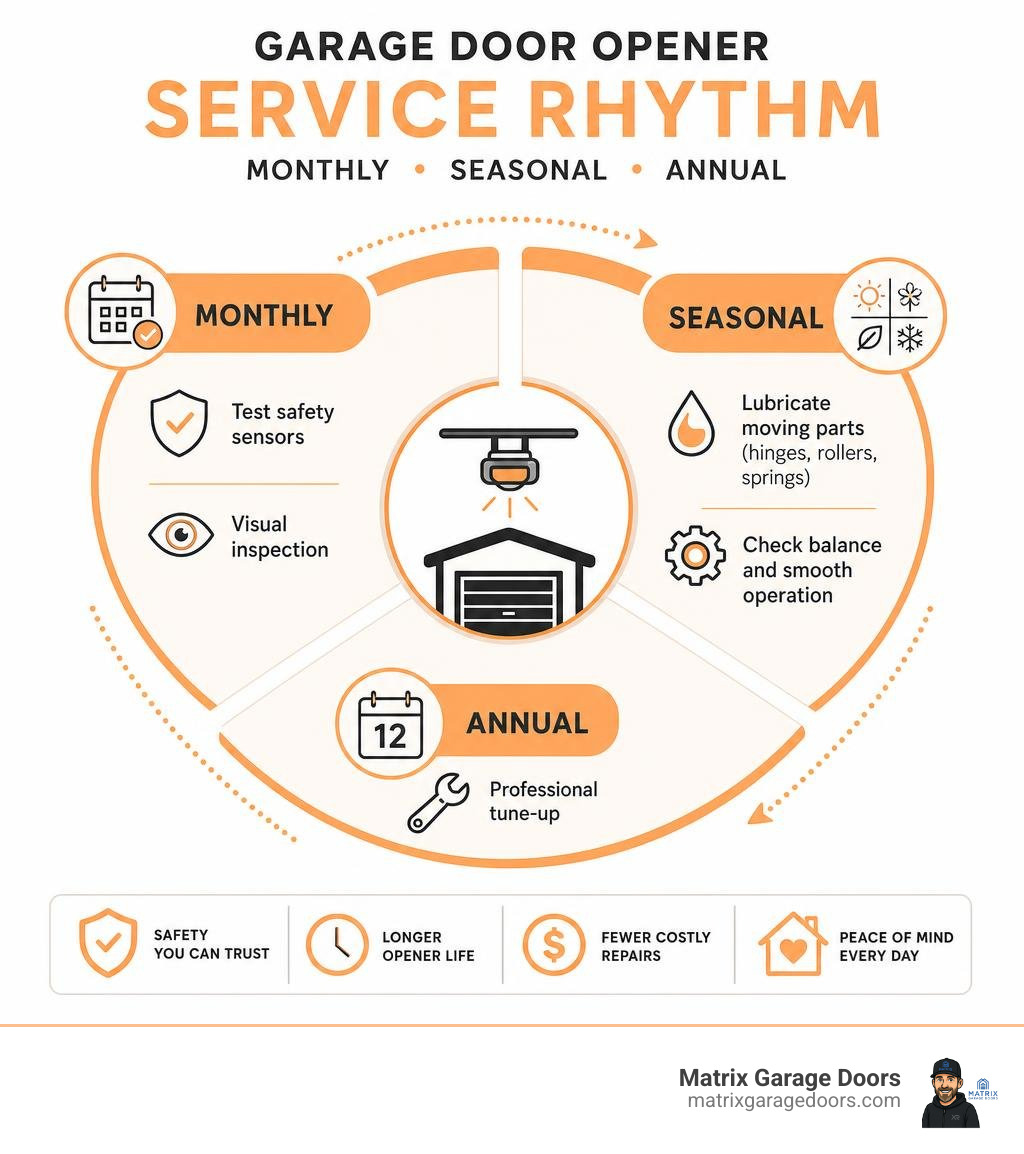
| Safety sensor test | Monthly |
| Lubrication (hinges, rollers, springs) | Twice a year |
| Visual inspection | Monthly |
| Heavy-use or older openers (10+ years) | Every 6 months |
Your garage door is the largest moving system in your home. If you use it three times a day, that’s over 1,000 cycles per year — and more than 20,000 cycles over its lifetime. All that movement puts real stress on motors, sensors, springs, and drive systems.
The problem? Most people don’t think about their opener until something goes wrong. By then, a small fix has often turned into an expensive repair — or a full replacement.
Regular servicing catches wear early, keeps safety features working, and can mean the difference between an opener that lasts 10–15 years and one that gives out after just five.
I’m Andrew Hopson from Matrix Garage Doors, and I’ve spent years helping Columbus homeowners understand exactly what their garage door systems need to stay safe, quiet, and reliable. In this guide, I’ll walk you through everything you need to know about whether garage door openers need to be serviced, how often, and what that looks like in practice.
Know your do garage door openers need to be serviced terms:
Do Garage Door Openers Need to Be Serviced? The Short Answer and Schedule
The short answer is a resounding yes. Just like your car needs regular oil changes and your teeth need routine dental cleanings, your garage door opener requires preventative care to operate safely and efficiently. Skipping annual service can lead to unexpected failures, noisy operations, and even safety hazards.
To keep your system running smoothly, we recommend following a consistent schedule that combines quick homeowner checks with professional oversight. According to official garage door opener maintenance guidance, performing basic monthly tests and scheduling a professional check-up once a year is the best way to prevent premature failure. For a deeper dive into organizing these tasks, check out our annual service planning guide to stay on track.
How often do garage door openers need to be serviced by a professional?
For the average residential home in the Columbus area—whether you are in Dublin, Westerville, or Upper Arlington—you should have your garage door opener professionally serviced once a year.
However, your specific schedule might vary based on several factors:
- Twice-Yearly Service: Recommended for busy households where the garage door is the primary entry point, or if you have teen drivers and multiple delivery drops.
- Quarterly Service: Best for heavy-use, commercial-style traffic, or detached garages that double as busy workshops.
- Environmental Factors: If your garage is exceptionally dusty, humid, or subject to extreme Central Ohio temperature swings, your opener works harder and may require more frequent attention.
- System Age: If your opener is older than 10 years, biannual check-ups help keep the aging motor and gears in working order.
Do garage door openers need to be serviced if they seem to work fine?
“If it isn’t broken, don’t fix it” is a dangerous mentality when it comes to garage doors. An opener might seem to operate perfectly while silently straining under the hood.
Hidden wear like sensor drift, a slightly loose chain, or incorrect belt tension can slowly destroy the motor. More importantly, if your garage door itself is unbalanced or has worn rollers, the opener has to work twice as hard to lift the heavy weight. This extra strain can burn out the motor gears. Regular servicing catches these minor issues early, preventing emergency breakdowns and protecting your manufacturer warranty.
The cycle-count rule homeowners can actually use
If calendar tracking feels too arbitrary, you can use the cycle-count rule. A “cycle” is one full opening and closing of the door.
Most garage doors experience about three daily cycles, which adds up to over 1,000 cycles a year. Over a standard 15-to-20-year door lifespan, that is more than 20,000 cycles! If you live in a busy household in Hilliard or New Albany where the door is constantly cycling, you should schedule a professional tune-up every 3,000 cycles.
The Safe DIY Maintenance Checklist Between Professional Visits
While complex mechanics should be left to the experts, there are several simple maintenance tasks you can safely tackle yourself to keep your system happy.
To keep your system in top shape, check out our comprehensive garage door maintenance checklist and explore our practical Garage Door Maintenance Tips to make DIY care a breeze.
Monthly safety checks every homeowner should perform
Every month, take five minutes to run through these three essential safety checks:
- The 2×4 Auto-Reverse Test: Place a flat 2×4 block of wood on the garage floor directly under the door’s path. Press the wall button to close the door. When the door strikes the wood, it must automatically reverse within two seconds. If it doesn’t, the force limits need adjustment.
- The Photo-Eye Interruption Test: While the door is closing, wave a broom handle in front of one of the safety sensors at the bottom of the tracks. The door should instantly stop and reverse. Ensure the lenses are clean and the indicator lights are not blinking.
- Visual and Remote Checks: Look over the door path for debris. Test your remote range and keypad response. If the opener light flashes when you try to close the door, it’s often a sign of misaligned sensors.
Seasonal DIY care: lubrication, cleaning, and battery checks
In Ohio, spring and fall are the perfect times to perform basic maintenance.
- Lubrication: Apply a high-quality silicone spray or white lithium grease to the hinges, metal rollers, and springs (visual-only application). Lubricate the opener rail and the chain or screw drive. Never use WD-40, as it acts as a degreaser and will strip away the necessary lubrication, leaving parts dry and vulnerable to rust.
- Cleaning: Wipe down the tracks with a clean rag to remove dirt and grime. Do not lubricate the tracks themselves, as this attracts dust and creates a sticky, abrasive paste.
- Batteries: Check the backup battery in your opener and replace the batteries in your remotes and keypads before the cold weather hits. For more details on quiet operation, check out our Garage Door Lubrication Service guide.
What not to touch: springs, cables, red bolts, and high-tension parts
Your garage door system is under immense tension. For your safety, never attempt to adjust or loosen:
- Torsion or extension springs
- Lift cables and drums
- Bottom brackets
- Any hardware painted red
These parts carry enough force to cause severe injury. If you notice frayed cables, a gap in your torsion spring, or if your door is visibly off-track, disconnect the opener and call a professional immediately.
DIY vs Professional Garage Door Opener Service: What Belongs Where
Knowing your limits is key to staying safe and keeping your warranty intact. Here is a quick breakdown of what you can do versus what requires professional training and diagnostic tools. We dive deeper into these boundaries in our guide on Garage Door Maintenance.
| Task | DIY Safe? | Requires Professional? |
|---|---|---|
| Visual inspection & track cleaning | Yes | No |
| Sensor alignment & lens cleaning | Yes | No |
| Battery & lightbulb replacement | Yes | No |
| Light lubrication of moving parts | Yes | No |
| Testing door balance manually | Yes | No |
| Torsion spring adjustment/replacement | No | Yes |
| Frayed cable replacement | No | Yes |
| Opener motor/gear diagnostics | No | Yes |
| Force calibration & travel limits | No | Yes |
| Track realignment or off-track repair | No | Yes |
Homeowner-safe tasks
As a homeowner, you can easily handle visual inspections, sensor cleaning, battery swaps, and light lubrication. You can also safely perform the manual balance test: disconnect the opener using the red emergency release cord, lift the door halfway, and let go. If it stays in place, your door is balanced. If it falls or shoots upward, the springs need professional adjustment.
Professional-only tasks
Professionals handle high-tension spring adjustments, cable replacements, and complex motor diagnostics. If your opener has a stripped gear, a failed logic board, or requires travel limit recalibration, specialized training is necessary to prevent electrical shocks or mechanical accidents.
Common DIY mistakes to avoid
- Using WD-40 on tracks and rollers: This attracts dirt and grinds down the bearings.
- Overtightening the chain or belt: This puts massive strain on the drive gear.
- Ignoring an unbalanced door: Forcing a struggling opener to lift an unbalanced door will quickly burn out the motor.
- Bypassing safety sensors: Never tape or wire safety sensors together to bypass a misalignment issue.
Warning Signs Your Opener Needs Service or Replacement
Your garage door opener will usually tell you when it is unhappy. Paying attention to early warning signs can save you from being trapped inside your garage on a busy morning.
If you notice persistent issues, it might be time to look into a Garage Door Opener Installation to upgrade to a safer, quieter model.
Service-needed symptoms that should not wait
Contact a technician if you experience:
- Unusual Noises: Grinding, squealing, scraping, or loud banging sounds.
- Delayed Response: The door hesitates for several seconds after you press the remote.
- Jerky Movement: The door shakes or moves unevenly along the tracks.
- Spooky Behavior: The door reverses unexpectedly or opens entirely on its own at night.
- Heavy Manual Lift: If you disconnect the opener and cannot easily lift the door with one hand, your springs are failing.
Repair vs replacement decision points
If your opener is under 10 years old, a minor repair like replacing a stripped drive gear or a logic board is highly cost-effective. However, if your unit is 15 years or older, lacks modern safety sensors (which became federally mandated in 1993), or requires repeated service calls, investing in a replacement is the smarter long-term choice. Modern openers also offer quiet belt drives, battery backups, and smart home connectivity.
How long garage door openers last with proper maintenance
With regular annual servicing, a quality garage door opener typically lasts 10 to 15 years. Premium belt-drive or jackshaft models can easily reach 15 to 20 years. On the other hand, a neglected opener operating a heavy, unbalanced door can fail in as little as 5 years. Extreme temperatures and power surges can also shorten motor life, making preventative care even more critical.
What a Professional Tune-Up Includes and What It Costs
When you hire a professional for a tune-up, they perform a comprehensive safety and mechanical inspection that goes far beyond basic DIY care.
For a complete breakdown of what to expect during a service visit, refer to our In-Depth Guide to Garage Door Maintenance.
Typical professional maintenance steps
A standard professional tune-up includes:
- Inspecting the entire opener motor, trolley, carriage, and rail.
- Tightening all mounting brackets and wall control wiring.
- Adjusting chain or belt tension to prevent sagging.
- Testing and aligning the photo-eye safety sensors.
- Checking the emergency release cord functionality.
- Testing the manual door balance and track alignment.
Safety tests every tune-up should include
A certified technician will always perform a force and travel limit calibration to ensure the door reverses immediately upon contact with an obstruction. They will also inspect the high-tension springs and lift cables for microscopic cracks or fraying, ensuring your system complies with modern safety standards.
Garage door opener tune-up cost in 2026
In June 2026, the average cost for a professional garage door opener tune-up typically ranges between $100 and $240. This usually covers:
- Labor: $75 to $100 for a multi-point safety inspection.
- Lubrication and Cleaning: $10 to $20.
- Minor Adjustments: Such as sensor alignment or chain tightening.
Note: If the technician discovers worn-out rollers, broken springs, or damaged gears, these parts will incur additional replacement costs. If you are looking for localized assistance in Blacklick, OH or surrounding areas, contact Matrix Garage Doors to get an upfront, transparent estimate.
Frequently Asked Questions About Garage Door Opener Service
Do garage door openers need to be serviced before winter?
Yes! Cold weather causes metal components to contract, thins out cheap lubricants, and reduces battery efficiency by 20% to 40%. A fall service ensures your system is properly lubricated and ready to handle freezing temperatures without seizing up.
Are garage door opener tune-ups worth it?
Absolutely. Spending a small amount on an annual tune-up prevents emergency repair bills that can easily cost hundreds of dollars. It also extends the lifespan of your motor and ensures your family remains safe from heavy, falling doors.
How do I avoid garage door opener service scams?
Always work with a local, highly-reviewed company. Beware of ultra-low “coupon” deals that seem too good to be true, as some untrustworthy providers use these to get their foot in the door and demand unnecessary, expensive spring replacements. Always ask for a written estimate before any work begins.
Conclusion: Keep Your Opener Happy and Safe
Taking care of your garage door opener is the easiest way to ensure your daily routines run smoothly. By combining simple monthly DIY checks with a professional annual tune-up, you can keep your system quiet, safe, and reliable for years to come.
If you live in Columbus, Bexley, Dublin, Westerville, Worthington, or any of our neighboring Central Ohio communities, our family-owned team at Matrix Garage Doors is here to help. We bring two decades of local experience to every job, offering prompt, professional service you can trust.
Ready to make sure your garage door opener is in top shape? Schedule expert opener installation or replacement help with us today, and let’s keep your door moving smoothly!