Springing for Savings: A Garage Door Springs Price Comparison
What You’re Actually Paying for Garage Door Springs in 2026
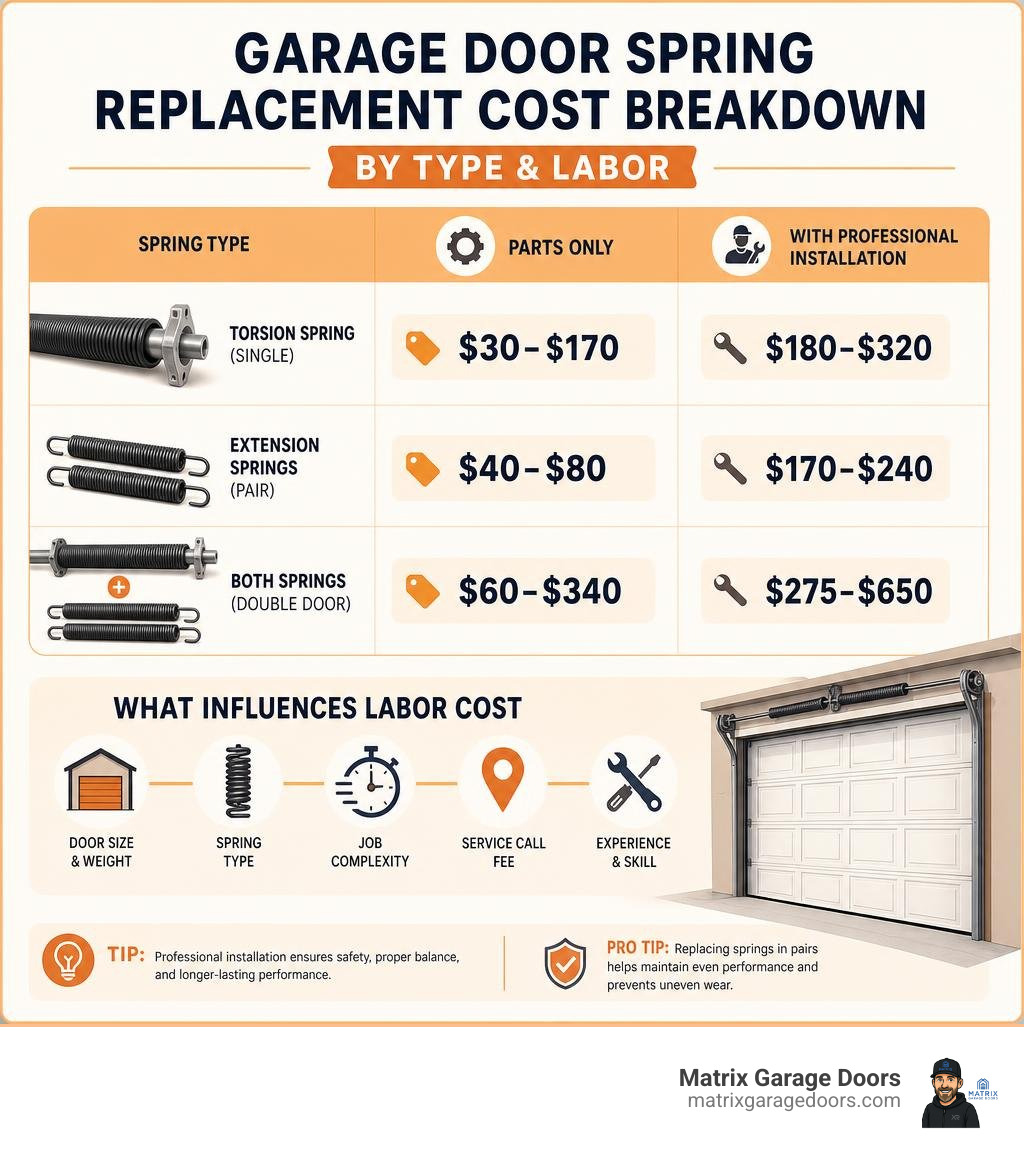
Garage door springs price is one of the first things homeowners want to know when a spring breaks — and the answer depends on a few key factors. Here’s a quick snapshot:
| Spring Type | Parts Only | With Professional Installation |
|---|---|---|
| Torsion spring (single) | $30–$170 | $180–$320 |
| Extension springs (pair) | $40–$80 | $170–$240 |
| Both springs (double door) | $60–$340 | $275–$650 |
Key numbers to remember:
- National average for spring replacement: ~$200
- Typical range (parts + labor): $119–$350 per spring
- Most homeowners pay: $450–$650 to replace a matched pair
- Service call fee: $75–$100 (often included in total quote)
One moment everything works fine. The next, your garage door won’t budge — and suddenly you’re faced with an unexpected repair bill and a car you can’t get out of the driveway. It’s one of the most common calls Matrix Garage Doors receives from Columbus homeowners.
The good news: understanding what drives the cost puts you in a much stronger position before you call anyone.
I’m Andrew Hopson with Matrix Garage Doors, and I’ve spent years helping Columbus-area homeowners navigate garage door springs price decisions — from simple single-spring swaps to full torsion conversions on heavy double doors. In this guide, I’ll break down exactly what you should expect to pay, and why.
Understanding the Average Garage Door Springs Price in 2026
When homeowners shop for garage door springs, there are really two prices to understand:
- The parts-only price if you buy the spring yourself
- The installed price if a professional supplies the spring and replaces it
In 2026, a basic replacement spring may cost far less online than the total repair invoice, but that does not mean the labor is “extra fluff.” Garage door springs are under serious tension, and the installed price usually includes the technician’s time, correct spring sizing, winding or tensioning, safety testing, disposal of the broken spring, and often a warranty.
A normal professional quote may include:
- Service call or trip fee
- Inspection of the spring system
- Correct spring measurement or door weighing
- New spring or matched spring pair
- Labor to remove the old spring
- Labor to install and tension the new spring
- Balance test
- Opener and hardware check
- Warranty on parts and labor
For a deeper look at what makes a spring quote fair, see our guide: More info on spring quotes.
Here is the practical comparison most Columbus-area homeowners need:
| Category | Torsion Springs | Extension Springs |
|---|---|---|
| Common parts-only cost | $30-$170 per spring | $40-$80 per pair |
| Common installed cost | $180-$320 per spring | $170-$240 per pair |
| Common location | Mounted above the garage door | Mounted along both horizontal tracks |
| Typical use | Modern sectional garage doors | Older or lighter residential doors |
| Durability | Often longer-lasting and smoother | Usually simpler but less controlled |
| Safety concern | High torque when wound | Needs safety cables to contain breakage |
| Best value for | Heavy doors, double doors, frequent use | Budget replacements on compatible doors |
The biggest price surprise? The lowest parts-only price is not always the lowest long-term cost. A spring that is slightly wrong for the door weight can make the opener work harder, cause the door to feel heavy, or fail earlier than expected. In other words, a cheap spring can become expensive quickly. Garage doors have a sense of humor, but unfortunately it is usually slapstick.
Torsion Springs vs. Extension Springs Cost Breakdown
Garage door springs do the heavy lifting by counterbalancing the door’s weight. Most residential garage doors weigh somewhere around 150 to 300 pounds, but when the springs are working properly, the door should feel much lighter and move smoothly.
The two most common residential spring systems are torsion springs and extension springs.
Torsion springs sit horizontally above the garage door opening. They twist to store mechanical energy and unwind as the door opens. Extension springs run along the sides of the door tracks and stretch when the door closes.
If you want the full mechanical breakdown, we explain it here: A Complete Guide to Torsion Springs.
From a price standpoint, extension springs usually cost less for parts and may be cheaper to replace. Torsion springs tend to cost more, but they usually offer smoother operation, better balance, and better durability on modern sectional doors.
Here is the simple rule we use with homeowners: replace the spring system with the same type unless there is a strong reason to convert. Converting from extension to torsion can improve performance, but it usually costs more than a standard replacement because it may require a torsion tube, drums, cables, bearing plates, and additional labor.
Torsion Garage Door Springs Price and Lifespan
Torsion springs are the most common choice for many modern residential garage doors in Columbus, Bexley, Dublin, Westerville, Grove City, Pickerington, and nearby communities we serve.
A single torsion spring replacement typically falls around $180 to $320 with parts and labor. For a double garage door with two torsion springs, many homeowners pay somewhere around $450 to $650 for a matched pair, depending on the door size, spring quality, cycle rating, and installation conditions.
Parts-only torsion springs can vary widely. Basic residential torsion springs may fall near the lower end, while larger, longer, higher-cycle, or custom-size torsion springs cost more. Oil-tempered steel springs and galvanized springs are both common. Oil-tempered springs are widely used for strength and durability, while galvanized springs offer corrosion resistance and a cleaner appearance.
Most standard torsion springs are rated for around 10,000 cycles. One cycle means the door opens and closes once. If you use your garage door four times per day, that is about 1,460 cycles per year. At that pace, a 10,000-cycle spring may last roughly 7 years. If your family uses the garage as the main entrance, your springs may wear out faster.
High-cycle torsion springs cost more upfront, but they can be a smart buy if:
- You open and close the door many times per day
- You have a heavy insulated door
- You want fewer future repairs
- You plan to stay in the home for several years
- You want better long-term value instead of the lowest first price
For more details on torsion spring failure, symptoms, and repair options, read Everything You Need to Know About Broken Torsion Springs.
Extension Garage Door Springs Price and Safety Cables
Extension springs are usually less expensive than torsion springs. A pair of extension springs often costs around $40 to $80 for parts, with professional replacement commonly landing around $170 to $240 for the pair.
They are often found on older or lighter garage doors. They work by stretching and contracting along the tracks. That design is simple, but it comes with an important safety note: extension springs should have safety cables.
A safety cable runs through the spring and helps keep it contained if it breaks. Without a safety cable, a broken extension spring can whip around the garage. That is not the kind of surprise anyone wants next to a car, window, freezer, bike rack, or your carefully stacked pile of “I’ll organize this later” boxes.
Extension spring costs may vary based on:
- Door height
- Door weight
- Spring length
- End type, such as double-loop or open-loop
- Whether safety cables need to be added or replaced
- Whether both springs are being replaced as a pair
Double-loop extension springs are common and generally stronger at the ends than open-loop designs. Open-loop springs may be easier to replace if the end breaks, but they are usually considered less durable.
For a broader explanation of spring types and installation considerations, see Mastering Garage Door Spring Installation.
Key Factors That Influence Your Replacement Costs

The average garage door springs price is helpful, but your actual cost depends on your specific door. A spring is not a one-size-fits-all part. It has to match the door’s weight, height, track setup, and hardware.
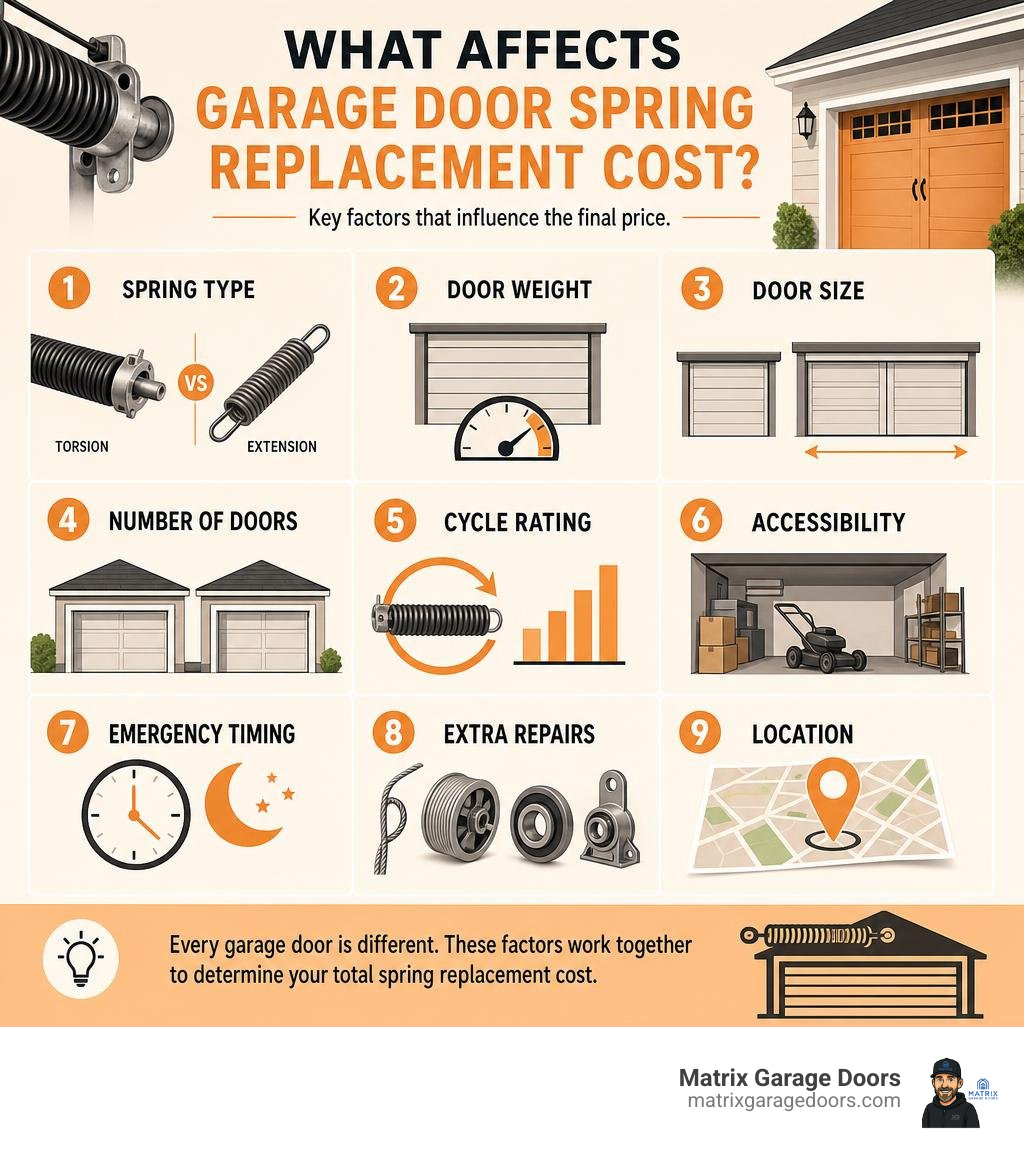
The biggest cost factors include:
| Cost Factor | How It Affects Price |
|---|---|
| Spring type | Torsion springs usually cost more than extension springs |
| Door weight | Heavier doors require stronger or larger springs |
| Door size | Double doors often need two springs |
| Number of doors | Replacing springs on multiple doors increases parts and labor |
| Cycle rating | High-cycle springs cost more but last longer |
| Accessibility | Tight or cluttered garages can add time |
| Emergency timing | After-hours or urgent service may cost more |
| Extra repairs | Worn cables, drums, rollers, or bearings can add cost |
| Location | Pricing can vary by market and travel distance |
In our service area, we work throughout Columbus and nearby communities, including Bexley, Blacklick, Canal Winchester, Dublin, Etna, Galena, Grandview Heights, Grove City, Groveport, Hilliard, New Albany, Pickerington, Powell, Reynoldsburg, Upper Arlington, Westerville, and Worthington. Local pricing can vary slightly based on drive time, availability, and whether you need standard scheduling or 24/7 emergency service.
A few examples:
- A single-car garage door with one standard torsion spring may be on the lower end.
- A heavy insulated double door with two high-cycle torsion springs will cost more.
- A door with broken cables, worn bearings, or damaged drums will cost more than a spring-only job.
- A late-night emergency repair can cost more than a scheduled weekday appointment.
The number of springs matters, too. Some single doors have one spring. Many double doors have two. If one spring breaks on a two-spring system, the second spring has usually gone through the same number of cycles and may be close to failing.
For more budgeting details, visit Cost to Replace Springs in Garage Door.
Professional Installation vs. DIY: Is It Worth the Risk?
We understand the appeal of DIY. Buying a spring online for $50 or $100 feels much better than paying for a full service call. But garage door springs are one of those repairs where “saving money” can get complicated very quickly.
Torsion springs are wound under high torque. Extension springs are stretched under tension. If the wrong tool slips, the wrong set screw loosens, or the spring is mis-sized, the result can be serious injury or damage to the door system. For general background on how garage door systems work, see this overview of a garage door.
Professional installation costs more than buying parts alone, but it gives you several important protections:
- Correct spring sizing
- Proper winding or tensioning
- Safer removal of the broken spring
- Inspection of cables, drums, bearings, rollers, hinges, and opener
- Door balance testing
- Warranty coverage
- Lower risk of damaging the garage door opener
- Faster repair, especially when your car is trapped inside
The specialized tools matter. Torsion springs require proper winding bars, not screwdrivers, pliers, or whatever tool happens to be closest on the workbench. Using the wrong tool is like using a butter knife to change a tire. Creative? Yes. Wise? Not so much.
DIY spring replacement may also create hidden costs:
- Ordering the wrong spring size
- Replacing one spring when both are worn
- Damaging the torsion tube or drums
- Overworking the garage door opener
- Creating an unbalanced door
- Voiding product or labor warranties
- Paying for a professional later to correct the repair
If you are researching DIY to understand the process, safety, and tradeoffs, start with Safely Swap Your Garage Door Springs. But for most homeowners, we recommend professional service because the risk is high and the margin for error is small.
Frequently Asked Questions About Garage Door Springs
Garage door springs are small compared to the door, but they control a huge part of how the system works. Below are the questions we hear most often from homeowners comparing spring prices and replacement options.
Should both garage door springs be replaced at the same time?
In most two-spring systems, yes. We usually recommend replacing both springs at the same time, even if only one has broken.
Here is why: both springs were likely installed at the same time and have completed the same number of cycles. If one breaks today, the other may be near the end of its useful life. Replacing only one can leave the door slightly unbalanced and may lead to another service call soon.
Replacing both springs together can:
- Keep the door balanced
- Reduce strain on the opener
- Improve smoothness
- Lower the chance of another spring failure
- Save a second labor charge later
- Protect warranty coverage in some cases
Think of it like replacing tires on the same axle. Could you replace only one? Sometimes. Is the better long-term answer usually a matched pair? Absolutely.
For help after a spring failure, see Broken Spring Blues.
How do I know if my garage door spring is broken?
A broken spring is often obvious, but not always. The most common sign is a loud bang from the garage. Many homeowners describe it like a firecracker, a gunshot, or something heavy falling. That sound is often the spring snapping.
Other warning signs include:
- The garage door will not open
- The opener hums or strains but the door barely moves
- The door opens a few inches and stops
- The door feels extremely heavy when lifted manually
- The door rises unevenly
- The door slams shut
- The door will not stay open
- You see a visible gap in a torsion spring
- Extension springs look stretched, loose, or damaged
- Cables appear loose or tangled
- The top section bends when the opener tries to lift the door
If a torsion spring is broken, you may see a separation in the coil above the door. If an extension spring is broken, one side may hang loose or look longer than the other.
Do not keep pressing the opener button if the door is not moving. The opener is not designed to lift the full weight of the door without spring assistance. Continuing to run it can damage the opener, rail, gears, or door panels.
For troubleshooting help, read Garage Spring Fix.
How long do garage door springs typically last?
Most standard garage door springs last about 7 to 9 years, or around 10,000 up-and-down cycles. Some torsion springs may last longer, especially if they are high-cycle springs rated for 20,000 cycles or more.
Actual lifespan depends on:
- How often the door is used
- Door weight
- Spring quality
- Correct spring sizing
- Rust or corrosion
- Weather exposure
- Maintenance habits
- Whether the door is balanced
- Condition of cables, rollers, tracks, and bearings
A household that opens the garage twice a day may get many years from a standard spring. A busy family using the garage as the main entry may burn through cycles much faster.
Maintenance helps. We recommend:
- Lubricating springs 2 to 3 times per year with a garage-door-safe lubricant
- Watching for rust or corrosion
- Listening for squeaking or grinding
- Testing door balance periodically
- Scheduling service if the door feels heavy or uneven
- Keeping tracks and hardware clear of debris
- Replacing worn rollers or cables before they strain the spring system
Rust is a spring’s enemy. It increases friction and weakens the metal over time. If your spring looks rusty, squeals loudly, or the door feels heavier than it used to, it may be time for an inspection.
Conclusion
The right garage door springs price is not just the cheapest number on a parts page. It is the price that gets you the correct spring, safe installation, balanced door movement, reliable operation, and fewer surprise repairs later.
In 2026, most homeowners should expect spring replacement to fall somewhere between $119 and $350 per spring with parts and labor, while replacing a matched pair on a double door often lands around $450 to $650. Extension springs usually cost less, torsion springs usually cost more, and high-cycle springs can offer better long-term value for busy households.
At Matrix Garage Doors, we are a family-owned company serving Columbus, OH and surrounding communities with 24/7 emergency residential garage door repair, installation, and maintenance. With two decades of experience, we help homeowners choose the right spring for the right door, install it safely, and make sure the whole system works the way it should.
If your spring snapped, your door feels heavy, or your opener is struggling, do not wrestle with the door. Let us help.