Don’t Get Shocked by Electric Garage Door Opener Installation Costs
What Does Garage Door Opener Installation Actually Cost?
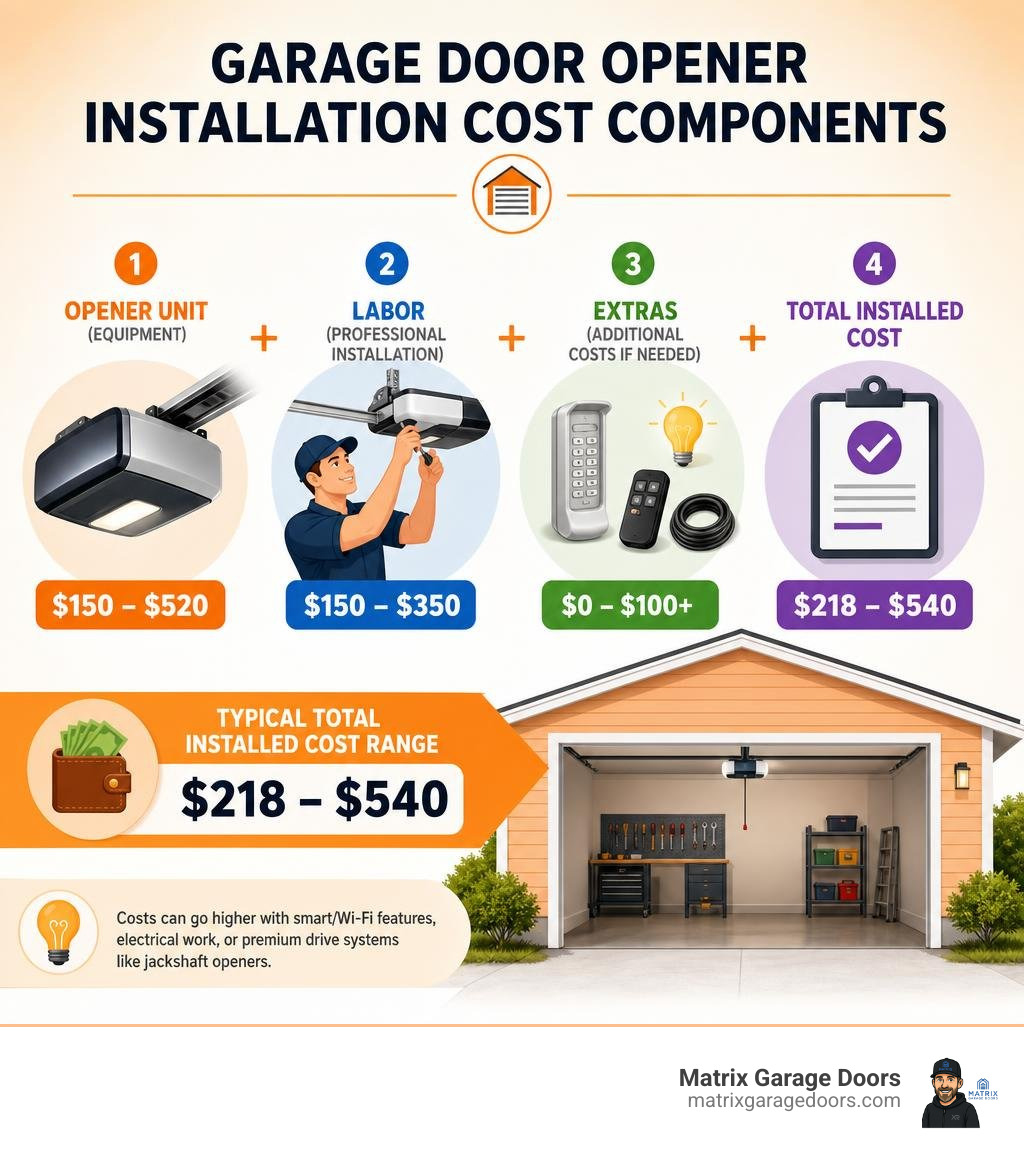
The cost for garage door opener installation typically falls between $218 and $540, with most Columbus-area homeowners paying around $379 when all is said and done.
Here’s a quick snapshot before we dig into the details:
| Cost Component | Typical Range |
|---|---|
| Opener unit (equipment) | $150 – $520 |
| Labor (professional installation) | $150 – $350 |
| Total installed cost | $218 – $540 |
| National average | ~$379 |
Note: Costs can go higher with smart/Wi-Fi features, electrical work, or premium drive systems like jackshaft openers.
Planning for a new garage door opener is one of those tasks that sounds simple until you start getting quotes. You might expect to pay a few hundred dollars and be done with it — then suddenly you’re hearing about disposal fees, extension kits, and whether your ceiling even has an outlet. It adds up fast, and without a clear picture of what drives the price, it’s easy to feel caught off guard.
The good news? Once you understand what goes into the total bill, the numbers make a lot more sense.
I’m Andrew Hopson from Matrix Garage Doors, and after years of installing and servicing openers for homeowners across the Columbus, Ohio area, I’ve seen every factor that shapes the cost for garage door opener installation — from basic chain-drive swaps to full smart-home setups. This guide breaks it all down so you can budget with confidence.
Cost for garage door opener installation vocabulary:
Average Cost for Garage Door Opener Installation
When you look at the big picture, the average national cost to professionally install a garage door opener hovers around $368 to $379, with a typical range of $218 to $540. However, the final price is highly dependent on whether you are buying a basic replacement unit or setting up a brand-new system where nothing existed before.
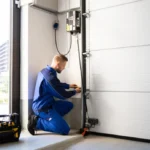
To get a clearer picture of what you are paying for, it helps to separate the equipment from the physical work. The average labor cost to install a garage door opener in the United States ranges from $150 to $350, with most homeowners paying right around $250 for the labor portion alone.
If you decide to purchase your opener through a major home improvement retailer and hire their contracted installers, you might see lower basic labor rates on paper, but those basic packages rarely cover the full scope of a real-world installation.
Below is a comparison of what you can expect when choosing between big-box retail installation programs and hiring an independent local garage door professional:
| Service Feature | National Retailer Installation | Independent Garage Door Pro |
|---|---|---|
| Base Labor Rate | $127 – $199 | $150 – $350 |
| Who Performs the Work? | Third-party local subcontractors | Certified, in-house technicians |
| Old Unit Disposal | Often an extra $20 – $40 fee | Usually included in the quote |
| Smart App Calibration | Often an extra $30 – $50 fee | Included with smart model installs |
| Custom Rail / Ceiling Work | Extra hourly charges apply | Factored into the upfront estimate |
| Labor Warranty | Typically 1 year | Often 1 to 2 years (or more) |
While big-box stores offer appealing entry-level pricing, local independent specialists provide a more comprehensive, all-inclusive service. For a detailed breakdown of service pricing structures, check out our Garage Door Service Price Guide. For broader industry pricing context and a deeper look at equipment rates, you can review the comprehensive guide on How Much Does Garage Door Opener Installation Cost? – Bob Vila.
Cost Breakdown by Garage Door Opener Type
The mechanical drive system you choose is the single largest factor in determining the baseline equipment price. Different drive styles offer varying levels of noise control, lifting power, and long-term durability.
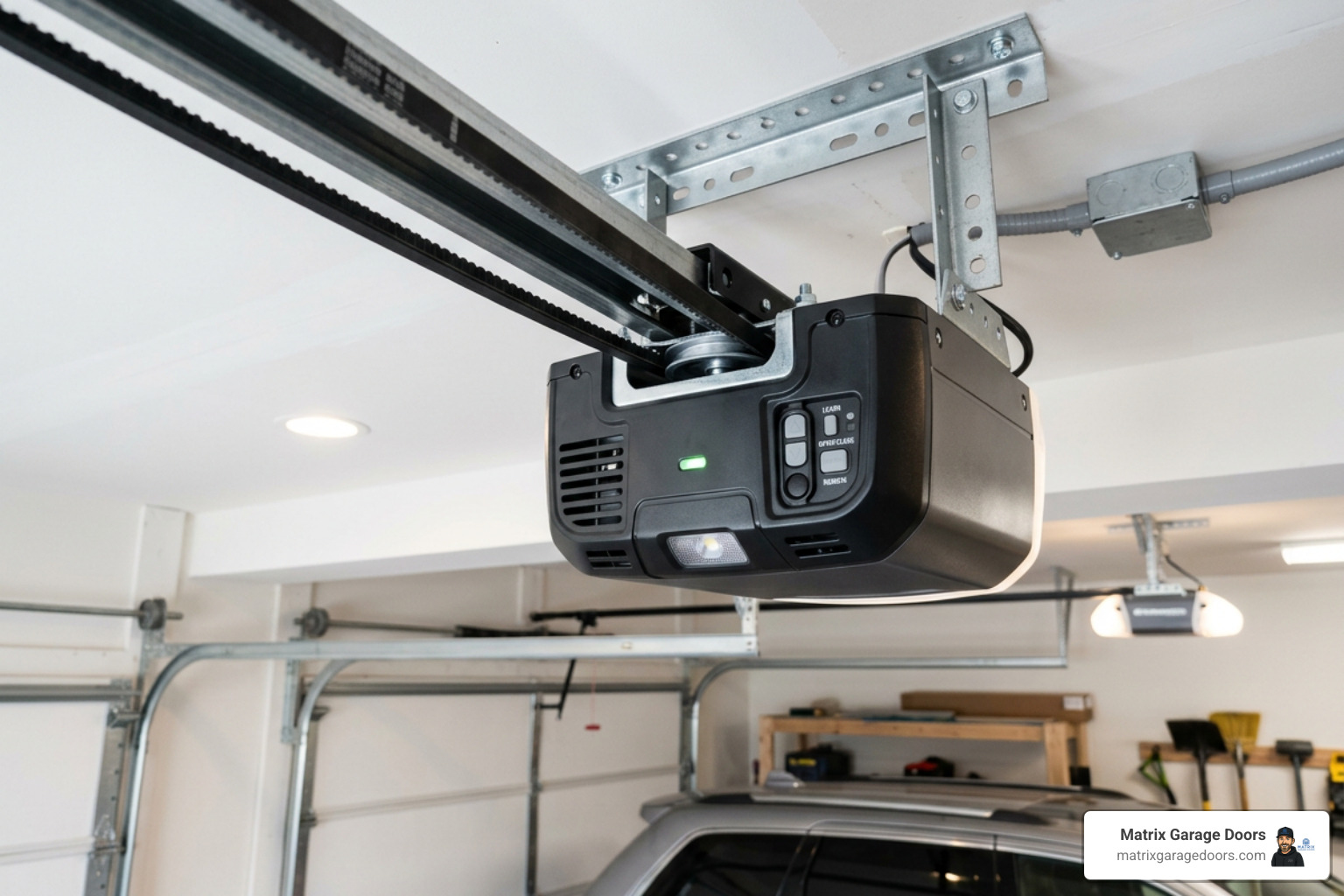
Choosing the right drive type is about balancing your budget with your home’s layout. If you have a bedroom directly above or adjacent to the garage, paying a bit more for a quieter system is almost always worth the investment. Let’s look at how the different drive types impact your overall cost for garage door opener installation. For a closer look at our specific setup services, visit our Garage Door Opener Installation page.
Chain-Drive and Belt-Drive Cost for Garage Door Opener Installation
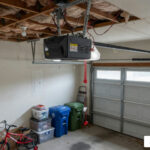
Chain-Drive Openers ($150 – $250 for the unit) Chain-drive systems are the most common and cost-effective options on the market. They rely on a metal chain—similar to a bicycle chain—to pull the trolley along the rail.
- The Pros: Highly durable, incredibly reliable, and very budget-friendly. They easily handle heavy double-car wood or insulated doors.
- The Cons: Metal-on-metal contact creates significant vibration and noise. If your garage is detached, a chain-drive is a fantastic way to save money. If your garage is attached to your home, the clanking noise might drive you crazy.
Belt-Drive Openers ($160 – $350 for the unit) Instead of a metal chain, belt-drive systems use a steel-reinforced rubber, polyurethane, or fiberglass belt to move the door.
- The Pros: They are virtually silent. Because there is no metal chain vibrating against a metal rail, the door glides open with a soft hum. They also require less ongoing maintenance than chain-drive systems.
- The Cons: They cost slightly more than chain-drive models, though the price gap has narrowed significantly in recent years.
Screw-Drive, Jackshaft, and Direct-Drive Cost for Garage Door Opener Installation
Screw-Drive Openers ($150 – $300 for the unit) Screw-drive systems use a threaded steel rod to rotate and move the trolley.
- The Pros: With fewer moving parts than chain or belt systems, they are highly reliable and require very little maintenance.
- The Cons: They operate at a moderate noise level—quieter than a chain but louder than a belt. Furthermore, screw-drive systems can struggle in climates with extreme temperature swings, as the lubrication on the threaded rod can freeze or attract dust.
Jackshaft (Wall-Mount) Openers ($500 – $750 for the unit) Unlike traditional trolley systems that hang from the center of the ceiling, jackshaft openers mount directly to the wall on either the left or right side of your garage door. They connect directly to the door’s torsion shaft to spin the spring bar and raise the door.
- The Pros: They completely free up your garage ceiling for overhead storage, work perfectly in garages with very low or exceptionally high ceilings, and run incredibly quietly.
- The Cons: They are premium units with a higher price tag and require professional installation due to the complexity of mounting them directly to the torsion assembly.
Direct-Drive Openers ($280 – $500 for the unit) In a direct-drive system, the motor is the trolley. Instead of a stationary motor pulling a chain or belt, the motor itself travels along a fixed track.
- The Pros: With only one moving part, direct-drive systems are virtually wear-free, exceptionally quiet, and require almost zero maintenance over their lifespan.
- The Cons: They are less common in the retail market, making parts and specialized installers slightly harder to find.
Key Factors Influencing Your Total Installation Bill
Beyond the physical drive mechanism, several secondary factors can push your installation bill higher or help keep it on the lower end of the spectrum. When planning your project, keep these key cost drivers in mind. You can also refer to our Garage Door Service Prices Guide to see how these factors interact with our standard service rates.
Horsepower, Brand, and Smart Wi-Fi Features
The size of your garage door determines how much horsepower (HP) your motor needs:
- 1/2 HP: The standard baseline. This is plenty of power for most single-car doors or lightweight, uninsulated double-car steel doors.
- 3/4 HP to 1-1/4 HP: Highly recommended for heavy carriage-house doors, solid wood doors, or heavily insulated double-car doors. Using an underpowered motor on a heavy door will cause the gears to strip and the motor to burn out prematurely.
- Brand Choice: Premium brands like LiftMaster (favored by professional installers for its commercial-grade build quality) generally cost more upfront than retail-focused brands like Chamberlain, Genie, or Craftsman. However, professional-grade brands often feature solid, single-piece rails that are much stronger than the multi-piece rails found in retail box sets.
- Smart Wi-Fi Features: Modern openers often feature built-in Wi-Fi, integrated security cameras, motion-activated LED lighting, and automatic deadbolts. While a basic opener might cost $150, a premium smart opener packed with these security features can easily run $400 to $600 for the equipment alone.
Geographic Location and Local Labor Rates
Where you live plays a major role in labor pricing. In dense, high-cost-of-living metropolitan areas, professional labor rates can range from $250 to $400. In smaller towns or suburban markets, those same labor rates might drop to $125 to $225.
For example, if you are looking at the Cost of a Garage Door Opener Installation in Etna, Ohio (2026), you will find that local rates align closely with the Midwest average, making professional installation highly accessible and competitive.
Retailers vs. Independent Pros: National Retailer Installation Costs
Many homeowners assume that buying an opener at a major home improvement retailer like Home Depot or Lowe’s and adding their installation service is the easiest way to save money. While the retail route is highly convenient, it is important to understand how their business model works.
Retail giants do not employ garage door installers directly. Instead, they act as brokers, outsourcing the physical labor to third-party local contractors in their network.
Here is what you should consider before booking through a national retailer:
- The Pricing Structure: The advertised basic installation fee (usually between $127 and $199) only covers a standard swap on an existing, perfectly balanced door with a working outlet nearby.
- Potential Hidden Add-ons: If the subcontractor arrives and discovers your ceiling is too high (requiring an extension kit), your door is unbalanced, or you want your smart app configured on your phone, they will charge additional modular fees that can quickly push the total past the cost of hiring a local specialist directly.
- Communication Barriers: If something goes wrong with the installation, you have to go through the retailer’s customer service department, which then contacts the subcontractor. This middleman dynamic can lead to scheduling delays and finger-pointing.
By hiring a dedicated local specialist directly, you get transparent, upfront pricing, personalized advice on which model actually fits your garage, and a direct line of communication if you ever need service. To learn more about full-system setups, check out our Garage Door Installation options.
Hidden Fees and Additional Installation Expenses
When budgeting for your project, it is easy to focus solely on the opener and the basic labor. However, real-world garages often present unique challenges that require extra parts or specialized labor.
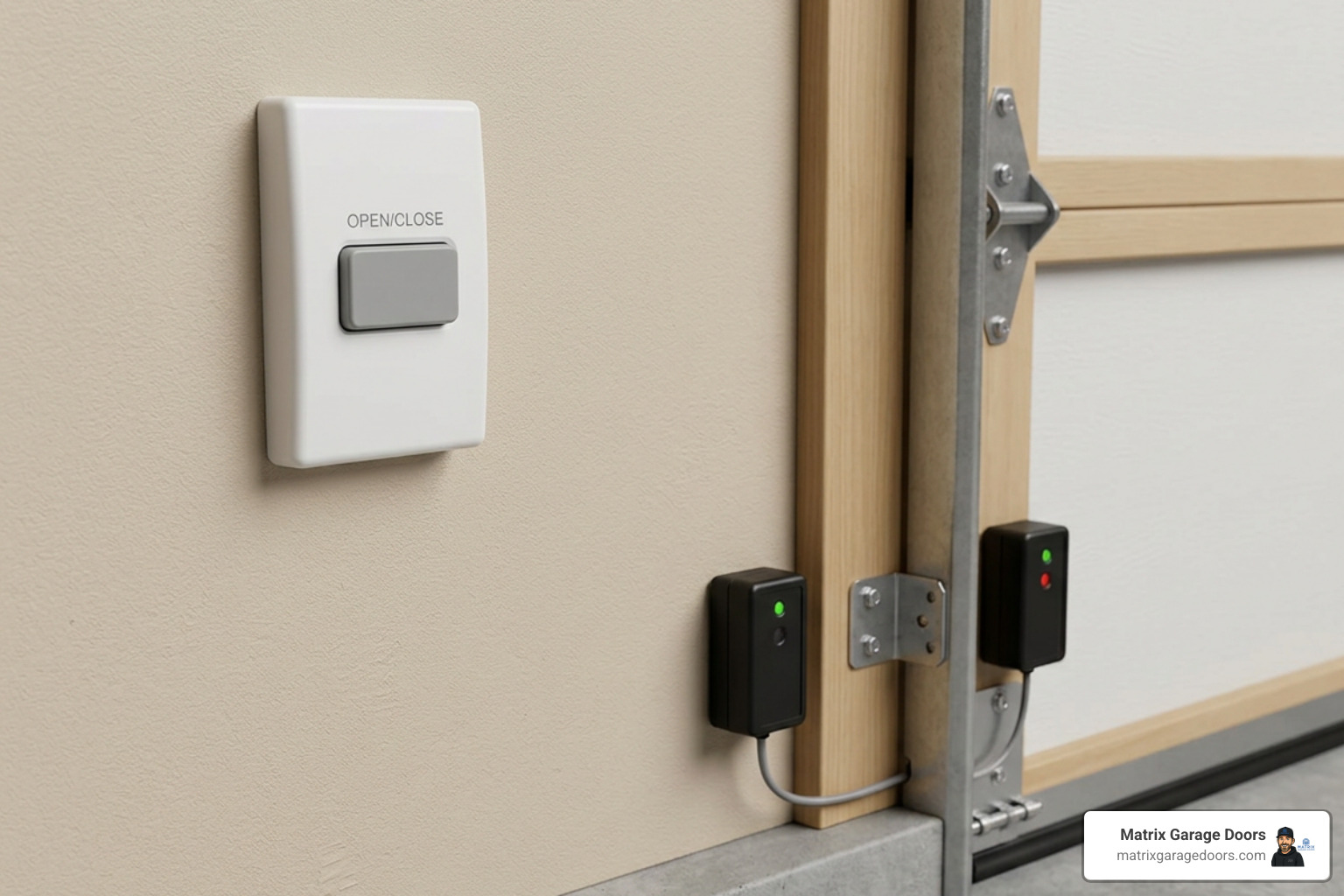
Here are the most common “hidden” costs that can pop up during an installation:
- Electrical Outlets ($150 – $300): Garage door openers must be plugged directly into a grounded outlet—extension cords are a major code and safety violation. If you do not have an outlet on your ceiling near the motor mount, you will need to hire a licensed electrician to run a dedicated circuit.
- Battery Backup Systems ($50 – $150): Many states and local municipalities now require garage door openers to feature battery backups so you can open your door during a power outage. If your chosen model does not include one, you may need to purchase it as an add-on.
- Extension Kits ($45 – $85): Standard retail openers are designed for 7-foot-tall garage doors. If your door is 8 feet tall or higher, you must buy an extension kit containing a longer rail and chain/belt to accommodate the extra height.
- Disposal and Haul-Away Fees ($20 – $40): Taking down an old, heavy steel opener leaves you with a bulky pile of scrap metal. While some local pros include haul-away in their base quote, others charge a small fee to dispose of the old equipment safely.
- Keypad Installation ($30 – $60): Adding an exterior wireless keypad is incredibly convenient for letting kids or service workers into the house without a remote. If you want to tackle this small accessory yourself, check out The 30-Minute DIY Guide to Garage Door Keypad Installation.
Frequently Asked Questions about Garage Door Opener Installation
How long does professional garage door opener installation take?
A professional technician can typically complete a standard garage door opener replacement in 1 to 2 hours. If it is a brand-new installation where no opener has ever been installed, the process can take 2 to 4 hours because the technician must run mounting brackets, hang the motor housing from the joists, install the wall button, run low-voltage wiring for the safety sensors, and program the remotes.
When is it better to repair vs. replace a garage door opener?
As a general rule of thumb, garage door openers have a useful lifespan of 10 to 15 years.
- When to Repair: If your opener is under 10 years old and experiencing a simple, isolated issue—such as a worn-out drive gear, a misaligned safety sensor, or a dead remote battery—a repair is usually the most cost-effective route.
- When to Replace: If your opener is over 12 years old, makes excessive grinding noises, operates intermittently, or lacks modern safety features (like rolling code security or safety sensors, which became federally mandated in 1993), it is time to replace it. Additionally, if the cost of a single repair exceeds 50% of the price of a new unit, investing in a modern, reliable replacement is the smarter financial decision.
What is typically included in a professional installation service?
When you hire a professional garage door service, a standard installation package should include:
- Site Inspection: Checking the balance and alignment of your existing garage door (an unbalanced door will quickly destroy a brand-new opener).
- Teardown & Disposal: Safely removing and hauling away your old motor, rail, and hardware.
- Assembly & Mounting: Putting together the new rail, securing the motor head to the ceiling joists, and attaching the drawbar to the door.
- Safety System Setup: Installing and precisely aligning the infrared safety sensors near the floor.
- Wiring & Programming: Running low-voltage wiring to the wall console, programming all handheld remotes, wireless keypads, and smart-home applications.
- Testing & Calibration: Setting the travel limits and force adjustments, performing safety reversal tests, and lubricating the door’s hinges and rollers.
Conclusion
Upgrading your garage door opener is an investment in your home’s security, convenience, and daily peace of mind. By understanding the various factors that shape the cost for garage door opener installation, you can confidently choose the perfect system for your budget and lifestyle without any unexpected surprises on the final invoice.
At Matrix Garage Doors, we pride ourselves on delivering transparent, honest pricing with absolutely zero hidden fees. As a family-owned company based right here in Columbus, Ohio, we bring two decades of professional experience to every single driveway we pull into.
Whether you need a quiet belt-drive system installed in Dublin, a heavy-duty chain-drive in Grove City, or emergency repairs in Westerville, our team is ready to help 24 hours a day, 7 days a week. We proudly serve homeowners across the entire Columbus metro area, including Bexley, Blacklick, Canal Winchester, Etna, Galena, Grandview Heights, Groveport, Hilliard, New Albany, Pickerington, Powell, Reynoldsburg, Upper Arlington, and Worthington.
Ready to upgrade your home with a reliable, professional garage door opener installation? Check out our full range of Garage Door Services or give us a call today to schedule your free estimate!