Everything You Need to Know About Broken Torsion Springs
Why Extension Spring Replacement Matters for Your Garage Door
Extension spring replacement is one of the most common — and most important — garage door repairs a homeowner will face. Here’s what you need to know at a glance:
Quick overview:
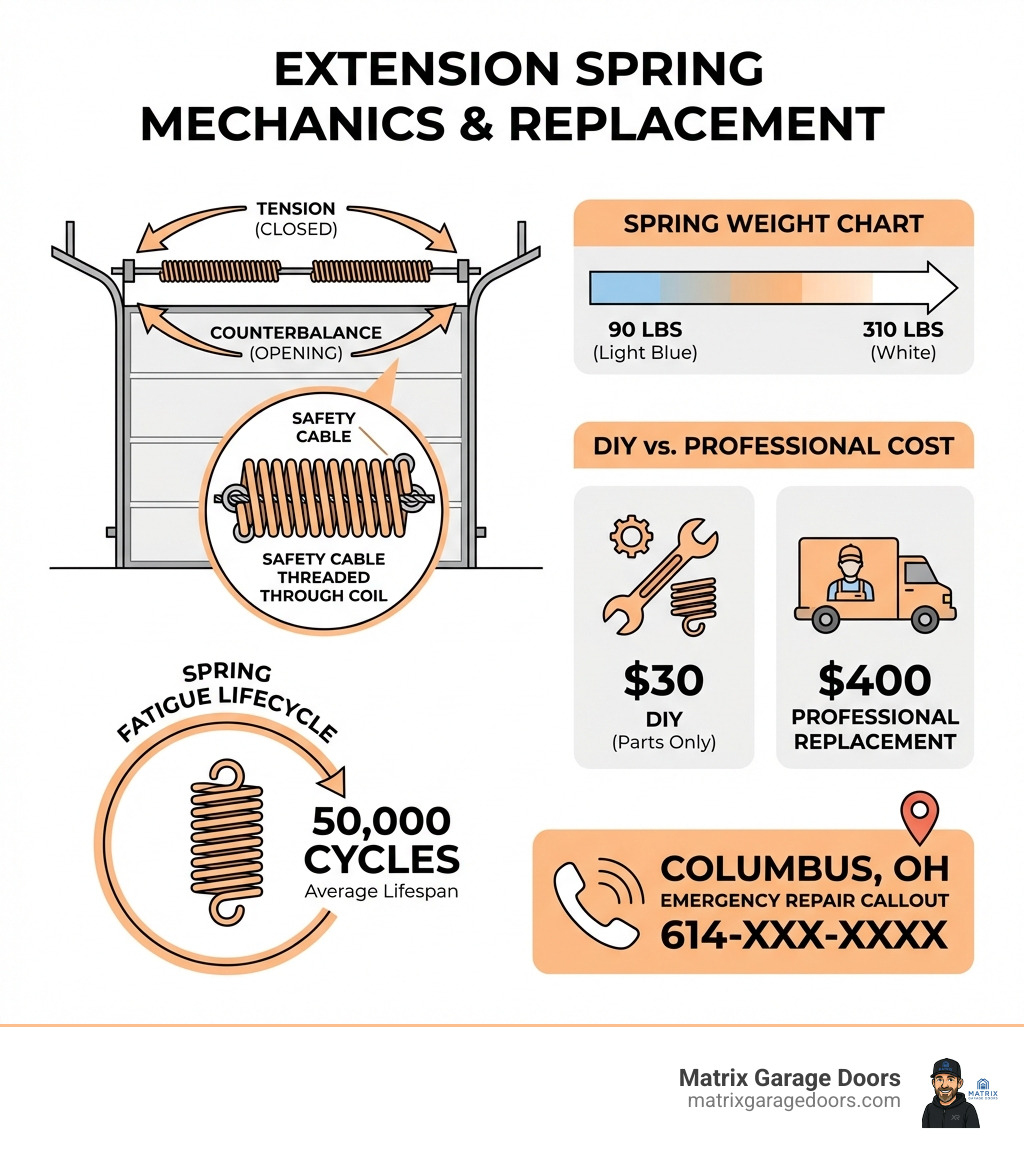
- What they do – Extension springs stretch and contract to counterbalance the full weight of your garage door (typically 150–300 lbs), making it easy to open and close.
- When to replace – Replace when springs are visibly worn, stretched beyond 75 inches, rusted, or causing the door to move unevenly or not at all.
- How to choose the right spring – Match the spring to your door’s actual measured weight using color-coded ratings (e.g., White = 110, 210, or 310 lbs).
- DIY cost vs. professional – Parts alone run about $30; professional replacement typically costs around $400.
- Safety first – Always secure the door with clamps, wear safety glasses and gloves, and ensure safety cables are in place before touching any spring hardware.
Extension springs sit above the horizontal tracks on each side of your garage door. They store mechanical energy when the door closes and release it when the door opens. Over time — typically around 50,000 open-and-close cycles — that constant tension wears them down. When a spring fails, the door can become impossible to lift, slam shut unexpectedly, or move at an uneven, jerky angle. For homeowners in Columbus, OH, that kind of failure rarely happens at a convenient time.
This guide walks you through everything: how to spot failure early, how to measure and select the right replacement spring, and how to replace it safely — step by step.
I’m Andrew Hopson from Matrix Garage Doors, a residential garage door company serving the greater Columbus, Ohio area, with years of hands-on experience in extension spring replacement, complex repairs, and full system inspections. I’ll give you the straightforward, safety-first guidance you need to handle this repair with confidence.
Understanding Extension Spring Replacement and System Mechanics
When we talk about the mechanics of your garage door, we are really talking about a delicate balancing act. Extension springs are the muscles of the operation. Located horizontally above the upper tracks, these springs work by stretching out as the door closes. This stores “initial tension.” When you go to open the door, that stored energy is released, helping to pull the weight of the door upward.
Without these springs, your garage door opener would have to lift 150 to 300 pounds of dead weight every single time. That would burn out a motor faster than you can say “Columbus Buckeyes.” Properly functioning springs provide a counterbalance that allows you to lift the door with just one hand if the opener is disconnected.
The Lifecycle of a Spring
Most residential extension springs are rated for approximately 50,000 cycles. One cycle is one full opening and closing of the door. While that sounds like a lot, consider how often you leave for work, come home for lunch, or let the kids in and out. Over years of use, the metal undergoes fatigue. The spring loses its “linear rate”—meaning it no longer provides the same amount of lift per inch of stretch.
Measuring your garage door extension springs is the first step in any successful replace-garage-door-spring project. You need to know exactly how much weight the spring is supporting to ensure the system remains balanced. If the spring is too weak, the door will feel heavy; if it’s too strong, the door might fly open or refuse to stay closed.
Identifying Wear in Extension Spring Replacement Components
It isn’t always the spring itself that snaps first. The extension spring system relies on a network of pulleys and cables. If a pulley bearing wears out, it can cause the cable to rub against the track, leading to a garage-spring-fix that requires more than just a new coil.
Keep an eye out for these red flags:
- The 75-Inch Rule: A standard extension spring is usually 25 to 27 inches long when relaxed. When the door is closed, it stretches to about 67 inches. If you measure your spring while the door is closed and it exceeds 75 inches, the metal has “set” and lost its elasticity. It’s time for an extension spring replacement.
- Gaps in the Coils: If you see visible gaps between the coils when the spring is relaxed (door open), the spring is failing.
- Frayed Cables: Look at the lift cables. If you see “hairiness” or broken strands, the How to Replace Garage Door Extension Cable process needs to happen immediately to prevent the door from falling.
- Worn Pulleys: If the door makes a scraping sound or jerks as it moves, the pulleys may be flat-spotted or the bearings may be shot.
Signs of Failure and Selection Criteria
Selecting the right hardware is the most technical part of the job. You cannot simply buy “standard” springs and hope for the best. Garage doors vary wildly in weight based on their material, insulation, and size. For example, a 14×7 foot insulated steel door might weigh 220 lbs, requiring a much heavier spring than a non-insulated door of the same size.
To get it right, we recommend the analog scale method. With the door closed and all spring tension removed (safety first!), place a bathroom scale under the center of the door to get an accurate weight.
The Color Code System
The industry uses a standardized color-coding system to indicate the weight capacity of extension springs. These colors are usually painted on the ends of the springs. However, be careful—white can represent 110 lbs, 210 lbs, or 310 lbs depending on the manufacturer and the door height.
| Color Code | Weight Capacity (lbs) | Typical Door Type |
|---|---|---|
| Light Blue | 90 / 190 / 290 | Small Single Doors |
| Tan | 100 / 200 / 300 | Standard Single Doors |
| White | 110 / 210 / 310 | Insulated Steel 14×7 |
| Green | 120 / 220 / 320 | Heavy Double Doors |
| Gold | 80 / 180 / 280 | Lightweight Aluminum |
When looking at the cost-to-replace-springs-in-garage-door, you should always replace both springs at the same time. If one has snapped, the other has likely reached the end of its fatigue life as well.
Professional Sizing for Extension Spring Replacement
Beyond weight, you must consider the door height. A 7-foot door typically uses 144-inch cables, while an 8-foot door requires 156-inch cables. Using the wrong length will prevent the door from opening fully or closing securely.
When selecting your new springs, look for double looped ends. We find these are the most durable and universally compatible options. They are easier to hook into the pulley forks and provide a more secure connection than single loops or clip-ends. Also, pay attention to the wire gauge. A 0.177 diameter is common for residential doors, but heavier setups may require a thicker gauge to handle the load safely. If you are unsure, our fix-garage-door-spring-cable experts can help you identify the exact specifications needed for your specific door model in Dublin or Westerville.
Step-by-Step Installation and Safety
If you decide to tackle this as a DIY project, safety is your absolute priority. These springs are under enough tension to cause serious injury if they break or slip during installation.
Tools and Safety Gear Needed:
- Safety glasses and heavy-duty leather gloves.
- Two C-clamps or locking pliers (Vise-Grips).
- Stepladder.
- Wrench set.
- New extension springs, cables, and pulleys.
The Replacement Process
- Secure the Door: Open the garage door fully. This is the position where the springs have the least amount of tension. Place C-clamps or locking pliers on the track under the bottom rollers on both sides to prevent the door from moving.
- Disconnect the Opener: Unplug the garage door opener and pull the emergency release cord. You don’t want anyone accidentally hitting the remote while you’re working.
- Release Tension: Disconnect the spring from the rear track hanger and the pulley. Since the door is open, the tension should be minimal, but still handle the hardware with care.
- Remove Old Components: Take off the old springs, safety cables, and pulleys. This is the perfect time to inspect the tracks for rust or debris.
- Install Safety Cables: If your door doesn’t have safety cables, install them now. Thread the safety cable through the center of the new spring and secure it to the track support and the wall bracket. This cable is what prevents a broken spring from flying through your garage like a missile.
- Attach New Springs and Pulleys: Hook the new spring to the rear track hanger. Attach the pulley to the other end of the spring using the pulley fork.
- Thread the Lift Cable: Run the lift cable from the bottom corner of the garage door, over the stationary pulley, through the spring pulley, and back to the track adjustment bracket.
- Balance and Adjust: This is the “feel” part of the job. Once both sides are installed, remove the clamps and manually lower the door halfway. If it stays in place, it’s balanced. If it falls, you need to tighten the cable tension. If it flies upward, the tension is too high.
- Lubrication: Apply a silicone-based garage door lubricant to the new springs and pulleys. This reduces friction and prevents rust, extending the life of your extension spring replacement.
Frequently Asked Questions about Extension Springs
How do extension springs differ from torsion springs?
Torsion springs are mounted on a metal shaft directly above the door opening. They twist to create torque. Extension springs, as we’ve discussed, sit along the horizontal tracks and stretch. Extension springs are generally more common in older homes or garages with low headroom. While extension springs are easier for a DIYer to replace because they don’t require specialized winding bars, they are generally considered more dangerous if they break without a safety cable. Torsion springs stay on the shaft even when they snap, whereas an extension spring can become a projectile.
What is the role of safety cables?
Safety cables are the most critical safety feature of an extension spring system. They run through the hollow center of the spring and are anchored at both ends. If the spring snaps—which often happens at the hook where the metal is most stressed—the safety cable catches the spring and keeps it from hitting your car, your windows, or a person standing nearby. Never operate a door with extension springs that lacks safety cables.
When should I call a professional for spring repair?
While a $30 DIY fix is tempting compared to a professional service call, there are times when you should absolutely call us at Matrix Garage Doors:
- The door is exceptionally heavy: If you have a solid wood door or a triple-layer insulated door, the tension involved is much higher.
- You lack the tools: If you don’t have sturdy clamps or a safe ladder, don’t risk it.
- The door is crooked: If the door is jammed in the tracks at an angle, the cables may be tangled or the tracks bent. This requires professional realignment.
- You don’t feel comfortable: There is no shame in prioritizing your safety. We offer 24/7 emergency service across Columbus, OH, to handle these high-tension repairs safely and quickly.
Conclusion
Your garage door is likely the largest moving object in your home, and the extension springs are what make that movement possible. Regular maintenance and timely extension spring replacement are the keys to a safe, quiet, and reliable garage. By keeping an eye out for frayed cables and stretched coils, you can prevent a total system failure before it happens.
At Matrix Garage Doors, we are a family-owned company with 20 years of experience serving our neighbors in Bexley, Blacklick, Canal Winchester, and the greater Columbus area. We pride ourselves on prompt, professional service and a commitment to customer satisfaction. Whether you need a simple tune-up or an emergency spring repair in the middle of the night, we are here to help.
If you’re noticing your door is getting heavy or noisy, don’t wait for a spring to snap. More info about garage door repair in Westerville, OH is just a click away, or you can give us a call to schedule a professional inspection. Stay safe, and keep those springs in check!