The Lazy Person’s Guide to Automatic Roll Up Garage Door Openers
Why an Automatic Roll Up Garage Door Opener Is Worth Every Penny
Quick Answer: How an Automatic Roll Up Garage Door Opener Works
| Step | What Happens |
|---|---|
| 1 | You press a remote, keypad, or app button |
| 2 | A motor unit engages the door’s rolling curtain or shaft |
| 3 | The door coils upward into a compact overhead roll |
| 4 | Safety sensors monitor for obstructions throughout |
| 5 | The door stops, reverses, or holds based on sensor input |
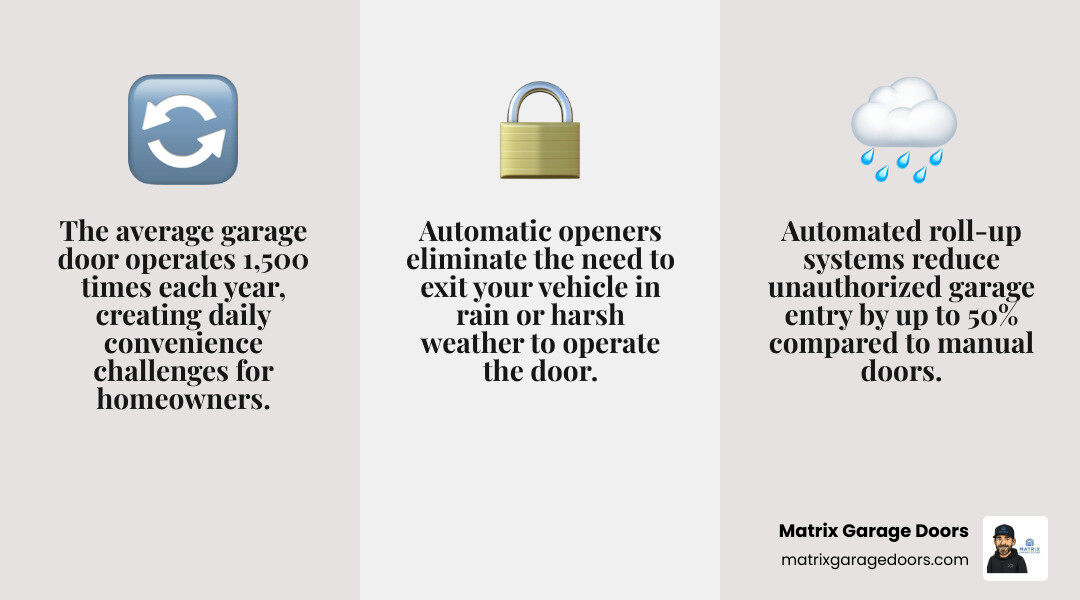
An automatic roll up garage door opener is one of those upgrades that sounds simple — until you realize just how much it changes your daily routine. Think about it: the average garage door is opened and closed around 1,500 times a year. That’s a lot of trips out of the car in the rain, a lot of manual lifting, and a lot of moments where you wonder whether you actually closed it before leaving.
For Columbus homeowners, that convenience factor is only part of the story. Automated systems also reduce unauthorized entry by up to 50% compared to manual doors — a serious benefit if your garage connects directly to your home.
Whether your old opener finally gave out or you’re automating a roll-up door for the first time, this guide walks you through everything you need to know to get it done right.
I’m Andrew Hopson from Matrix Garage Doors, and I’ve spent years helping Columbus-area homeowners select, install, and troubleshoot automatic roll up garage door openers across a wide range of residential applications. Let’s break down exactly what you need to know before you start.
Simple automatic roll up garage door opener glossary:
What is an Automatic Roll Up Garage Door Opener and How Does it Work?

When we talk about an automatic roll up garage door opener, we aren’t talking about the standard rail-and-trolley system you see in most suburban garages. Instead, these are compact, powerful motor units designed specifically for “sheet doors” or “rolling steel doors.”
Unlike sectional doors that slide back along the ceiling, a roll-up door coils into a tight roll above the door opening. The opener is usually a “jackshaft” or “side-mount” style unit that attaches directly to the door’s axle or curtain. When you hit the button, the motor rotates the shaft, either pulling the curtain up into a coil or unrolling it to close.
At Matrix Garage Doors, we often recommend this setup for homeowners in places like Grandview Heights or Upper Arlington who have limited headroom or want to keep their ceiling clear for storage. Modern systems use DC motors, which are significantly quieter and more efficient than older AC models.
The Easy Way to Automate Your Roll-Up Garage Door involves choosing a motor that matches your door’s “curtain” weight. Residential models are built for standard garage sizes, while commercial units are beefed up to handle heavy-duty warehouse docks.
| Feature | Residential Roll-Up Opener | Commercial Roll-Up Opener |
|---|---|---|
| Motor Power | 24V DC / approx. 600N-800N | 110V-220V / 1000N+ |
| Typical Usage | 3-5 cycles per day | High-frequency (25+ cycles) |
| Noise Level | Ultra-quiet (approx. 55 dB) | Moderate to High |
| Max Door Area | Up to 165 sq. ft. | Up to 300+ sq. ft. |
The Major Benefits of Upgrading to an Automated System
If you’re still jumping out of your car in a Pickerington thunderstorm to heave your garage door open, you’re living in the past. Beyond the obvious “I’m lazy and proud of it” factor, there are massive technical benefits to automation.
First, let’s talk security. Statistics show that automatic systems can reduce unauthorized entry incidents by up to 50%. Most modern openers use “rolling code” technology, which means the access code changes every single time you press the button. This prevents tech-savvy burglars from “grabbing” your signal.
Our Garage Door Services often focus on the longevity of your hardware. Manual operation is jerky and puts uneven stress on the door. Automated openers feature “soft start/stop” technology. This means the motor starts slowly, speeds up, and then slows down before finishing the cycle. This reduces wear and tear on your springs and tracks, potentially saving you thousands in repairs over the life of the door.
Furthermore, the global garage door opener market is booming — projected to reach $6.8 billion by 2030. This growth is driven by smart connectivity. High-performance belt drive openers now come with battery backup and Wi-Fi features. If the power goes out in Grove City, your door still opens. If you’re at work in New Albany and realize you forgot to close the door, you can fix it from your phone.
How to Install an Automatic Roll Up Garage Door Opener
Installing an automatic roll up garage door opener is a project many DIYers tackle, but it requires precision. If the door isn’t balanced, the motor will burn out in months.
- Check Your Balance: Before installing anything, pull the manual release and lift the door halfway. It should stay there. If it crashes down or flies up, your springs need professional adjustment.
- Verify Clearance: Most roll-up openers require a minimum of 11 inches of clearance between the door curtain and the mounting bracket (side-room).
- Mount the Motor: The unit typically slides onto the door’s axle. You’ll need to secure the mounting brackets to the wall or the door’s support structure.
- Engage the Drive: Connect the motor’s drive gear to the door’s drum or axle.
- Set Limits: This is the “brain” setup. You’ll program the “up” and “down” positions so the motor knows exactly when to stop.
- Install Safety Sensors: These must be aligned at the base of the tracks. If the beam is broken, the door won’t close.
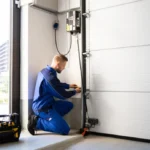
For a visual guide, check out this Roll Up Garage Door Opener Install – YouTube video. If you get halfway through and realize your side-room is too tight or your shaft is non-standard, don’t force it. Professional Garage Door Opener Installation ensures the motor is perfectly calibrated to the door’s weight.
Choosing the Right Automatic Roll Up Garage Door Opener for Your Space
Not all openers are created equal. To choose the right one, you need to know your door’s “Rated Door Area.”
- Small Doors (up to 12ft tall): A standard residential unit like the Model 1055 | Genie Garage Door Opener is perfect.
- Medium Doors (up to 14ft tall): Look for units with at least 800N of pulling force.
- Large/Wind-Locked Doors (up to 20ft tall): You’ll need a heavy-duty commercial-grade electric motor.
Always check the lift force. While DC motors aren’t measured in traditional horsepower, many are equivalent to 3/4 HP or 1-1/4 HP AC motors. For a heavy rolling steel door in a warehouse in Columbus OH, you’ll want that extra torque.
Safety, Security, and Smart Technology Requirements
In May 2026, a “dumb” garage door opener is a liability. Safety and smart features are now the industry standard.
Safety First: The Auto-Reverse Function Every quality automatic roll up garage door opener must have an auto-reverse function. If the door hits an object (or a pet) while closing, it must instantly stop and reverse. We also recommend units with “obstruction detection” that monitors the motor’s internal resistance.
Security: Rolling Codes and Deadbolts Look for “Security+ 2.0” or “Intellicode” technology. These systems use billions of code combinations to prevent hacking. Some side-mount openers even include an automatic power deadbolt that engages every time the door closes.
Smart Tech: Wi-Fi and Battery Backup Ultra-quiet Wi-Fi enabled garage door openers, like the B4505T | Ultra-Quiet Wi-Fi Garage Door Opener | Chamberlain , allow for smartphone alerts and remote operation. In California, law SB-969 requires battery backup on all openers, and while not mandated in Ohio, it’s a lifesaver during our Midwest storms.
Regular Garage Door Maintenance is the only way to ensure these features keep working. Sensors can get bumped out of alignment, and batteries eventually need replacing.
Troubleshooting Your Automatic Roll Up Garage Door Opener
Even the best tech has bad days. Here are the most common issues we see in the field:
- The Door Reverses Immediately: This is almost always a sensor misalignment. Check if the little LEDs on your safety eyes are solid. If they’re blinking, they can’t “see” each other.
- Remote Doesn’t Work: Before panic sets in, check the garage door remote battery. If that’s fine, you might need to re-sync the rolling code.
- Grinding Noises: This usually points to worn internal gears or a drive system that needs lubrication.
- Audio/Visual Service Reminders: Many modern units, like those from Automatic Technology, have built-in counters that beep or flash after a certain number of cycles to tell you it’s time for a tune-up.
If your motor is humming but nothing is moving, you might have a broken spring. This is a job for our Garage Door Repair Services, as springs are under immense tension and can be dangerous.
Frequently Asked Questions
How much side-room is required for a roll up opener?
For most residential roll-up openers, you need a minimum of 11 inches of clearance between the edge of the door curtain and the wall or mounting bracket. Some compact models can work with slightly less, but 11-12 inches is the “safe zone” for a standard installation.
Can I automate an existing manual roll up door?
Yes! As long as your manual door is in good structural shape and properly balanced, you can almost always add an automatic roll up garage door opener. You’ll just need to ensure there is enough space on the axle to mount the motor and that you have a power outlet nearby.
What happens to my automatic opener during a power outage?
If you have a model with a battery backup, like the 6690L | LiftMaster 1-1/4 HPs Belt Drive Opener, the door will function normally for several cycles. If you don’t have a backup, you’ll need to use the manual release cord (usually red) to disengage the motor and lift the door by hand.
Conclusion
Upgrading to an automatic roll up garage door opener isn’t just about being “lazy” — it’s about safety, security, and protecting your investment. Whether you’re in Westerville, Hilliard, or Reynoldsburg, having a reliable system that you can control from your phone provides a peace of mind that manual doors just can’t match.
At Matrix Garage Doors, we’ve spent two decades serving the Columbus, OH area. As a family-owned company, we take pride in offering 24/7 emergency residential garage door repair and professional installation. We know the local climate and the specific needs of Ohio homeowners.
If you’re ready to ditch the manual lift and step into smart, automated access, we’re here to help. From choosing the right motor to a flawless Garage Door Installation, our team ensures your door operates smoothly and safely for years to come.
Ready to automate? Contact us today for Professional Garage Door Opener Installation and experience the convenience you deserve.