A Complete Guide to Torsion Springs and How They Work
What Is a Garage Door Torsion Spring (and Why It Matters)
A garage door torsion spring is a tightly wound coil mounted above your garage door that stores mechanical energy to counterbalance the full weight of the door — making it easy to open and close without straining your opener or your back.
Here’s a quick summary of what you need to know:
| Topic | Key Facts |
|---|---|
| What it does | Stores and releases torque to lift and lower the door |
| Where it’s mounted | Horizontally above the garage door on a metal shaft |
| Typical lifespan | ~10,000 cycles (one open + one close = one cycle) |
| Common inside diameters | 1-3/4″, 2″, 2-1/4″, 2-5/8″ |
| Signs it’s broken | Loud bang, door won’t open, visible gap in coil |
| DIY risk level | High — springs are under extreme tension |
| Recommended action | Measure carefully, match specs, replace both springs |
Your garage door weighs anywhere from 150 to 300 pounds. Without a properly working torsion spring, that weight falls entirely on the opener — and on you.
When a spring fails, it usually happens suddenly. You might hear a loud bang from the garage. The door feels impossibly heavy. The opener strains or stops after a few inches. That’s your torsion spring telling you it’s done.
This guide covers everything: how torsion springs work, how to measure and identify the right replacement, safety precautions, materials, maintenance, and when to call a professional.
I’m Andrew Hopson with Matrix Garage Doors, and I’ve spent years helping Columbus-area homeowners diagnose, replace, and maintain garage door torsion springs across all types of residential doors. Whether your spring just snapped or you’re planning ahead, this guide will walk you through everything you need to make a confident, safe decision.
Garage door torsion spring terms explained:
Understanding the Garage Door Torsion Spring System
To understand how your door stays balanced, you have to look at the whole Torsion Spring System Overview. It isn’t just a spring sitting by itself; it’s a group of heavy-duty components working in unison.
The heart of the system is the torsion tube (or shaft), which runs through the center of the springs. On either side of the spring, you’ll find two different types of “cones.” The stationary cone is bolted to a center bracket, keeping one end of the spring fixed in place. On the other end is the winding cone, which is where the tension is actually applied and secured to the shaft.
At the ends of the torsion tube are the cable drums. These act like reels for the lift cables that attach to the bottom of your garage door. When the spring unwinds, it spins the shaft, which turns the drums and pulls the cables to lift the door. It’s a beautiful bit of engineering that handles about 95% of the door’s weight. For a deeper dive into what happens when this system fails, check out Everything You Need To Know About Broken Torsion Springs.
Torsion vs. Extension Springs: What’s the Difference?
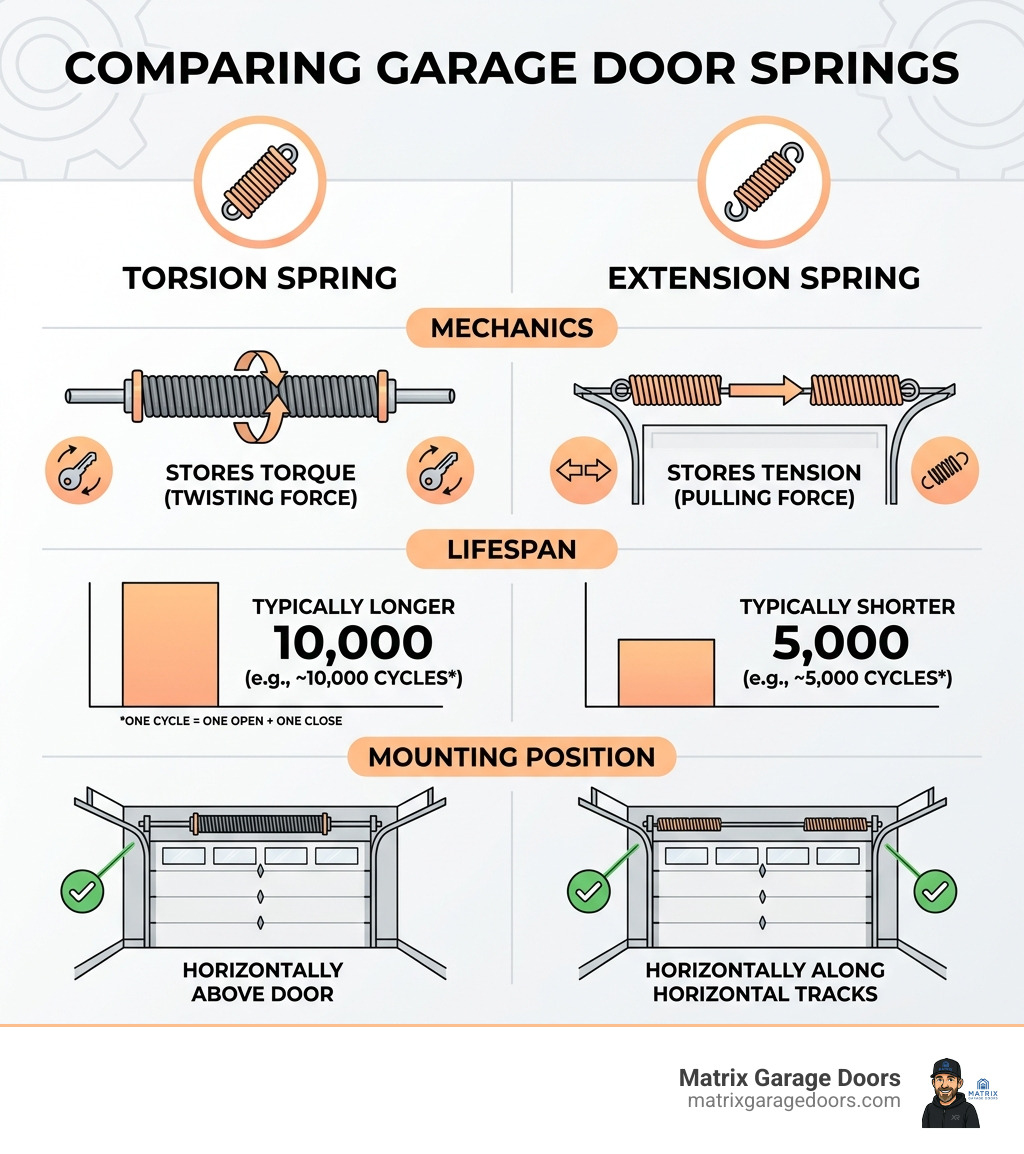
While torsion springs are the modern standard for residential doors in areas like Dublin and Westerville, some older homes still use extension springs. Here is how they stack up:
| Feature | Torsion Springs | Extension Springs |
|---|---|---|
| Mounting Position | Above the door header | Along the horizontal tracks |
| Movement | Twists (Torsion) | Stretches (Extension) |
| Safety | High (contained on a shaft) | Lower (can fly off if cable snaps) |
| Expected Life | 10,000 to 20,000+ cycles | 5,000 to 10,000 cycles |
| Balance | Smooth, controlled motion | Can cause “jerky” door movement |
How a Garage Door Torsion Spring Works
The magic of the garage door torsion spring lies in torque. When you close your garage door, the cables pull on the drums, which rotates the shaft and winds the spring. This stores up a massive amount of energy.
As of April 2026, the industry standard for a residential spring is still roughly 10,000 cycles. One cycle equals the door opening and closing once. When you press the button to open the door, that stored energy is released, providing the “oomph” needed to lift a 200-pound slab of steel. Without this counterbalance, your garage door opener would likely burn out its motor in a matter of days. For official manufacturer insights on these mechanics, you can refer to Garage Door Support.
Common Signs of a Broken Garage Door Torsion Spring
If you are reading this, there is a good chance you suspect something is wrong. Springs don’t usually “wear out” quietly; they go out with a bang—literally.
- The Loud Bang: Many homeowners in Hilliard or Grove City report hearing a sound like a gunshot or a heavy object falling in the garage. That is the steel coil snapping under hundreds of pounds of tension.
- The “Heavy” Door: If you try to pull the emergency release cord and lift the door manually, it won’t budge more than an inch or two. Without the spring, you are trying to deadlift the full weight of the door.
- Visible Gaps: Look at the spring above the door. If you see a 2-inch gap in the coils, the spring is broken.
- Jerky Movement or Crooked Alignment: If you have a two-spring system and only one breaks, the door may start to come up but will look crooked or get stuck in the tracks.
If you’re dealing with these symptoms, don’t panic. Read our guide on Broken Spring Blues Heres How To Fix Your Garage Door to understand your next steps.
How to Identify and Measure Your Torsion Springs
Ordering a replacement garage door torsion spring isn’t as simple as “one size fits all.” If you install a spring that is too strong, the door will fly open dangerously. If it’s too weak, the opener will struggle. Precision is everything.
To get the right match, you need four specific measurements:
- Inside Diameter (ID): Most residential springs in Central Ohio have an ID of 1-3/4″ or 2″. You can often find this stamped on the winding or stationary cones (e.g., “P175″ for 1-3/4”).
- Wire Gauge (Wire Size): This is the thickness of the steel wire itself. To measure this accurately without a micrometer, use the “20-coil rule.” Measure the length of 20 coils in inches (make sure they are compressed and touching), then divide by 20. For example, if 20 coils measure 5 inches, your wire size is 0.250.
- Spring Length: Measure the length of the spring from the first coil to the last. Do not include the cones in this measurement. If the spring is broken, you’ll need to push the two pieces together to get an accurate total length.
- Wind Direction: This is where many DIYers get tripped up. We’ll cover this in detail below.
For more technical tips on getting these numbers right, see our guides on Tension Torsion Extension Mastering Garage Door Spring Installation and Replace Garage Door Spring.
Determining Wind Direction for a Garage Door Torsion Spring
Torsion springs are either Left-Hand Wound (LHW) or Right-Hand Wound (RHW). This is not about which side of the door the spring sits on, but rather which way the wire coils.
The industry standard is “Inside Looking Out” (ISLO). Generally:
- The spring on the left side of the center bracket is usually Right-Hand Wound (often has a black cone).
- The spring on the right side of the center bracket is usually Left-Hand Wound (often has a red cone).
A quick trick: look at the end of the wire coil. If it points clockwise, it’s a different wind than if it points counter-clockwise. Getting this wrong means the spring will unwind instead of tightening when you try to use it. If you’re unsure, our Garage Spring Fix page has visual aids to help.
Safety Precautions and Essential Tools for Replacement
We cannot stress this enough: garage door torsion springs are dangerous. They hold enough energy to cause severe injury or even death if they release unexpectedly. If you choose to tackle this, you must have the correct tools and a healthy respect for the tension involved.

Essential Tool List:
- Winding Bars: Never, ever use screwdrivers or rebar. You need professional 1/2-inch diameter steel winding bars (usually 18 to 24 inches long) that fit perfectly into the winding cone.
- Locking Pliers (Vice-Grips): You’ll need these to lock the torsion shaft in place while you work.
- Wrenches/Sockets: Usually 7/16″ and 1/2″ for the cone set screws and center bracket bolts.
- Safety Gear: Impact-resistant safety glasses and heavy-duty gloves are non-negotiable.
Before you begin, ensure the door is fully closed and the opener is unplugged. You are dealing with a system that can lift 300 pounds; if that tension is released into a tool you are holding, it can be catastrophic. For a safety checklist, read Safely Swap Your Garage Door Springs And Save A Bundle and learn how to Fix Garage Door Spring Cable safely.
Choosing the Right Replacement: Cycles and Materials
When buying a new garage door torsion spring, you have choices that affect how long it will last.
- Standard Oil-Tempered Steel: These are the most common. They are durable and reliable for the standard 10,000-cycle life.
- Galvanized Coating: These springs have a zinc coating to prevent rust. They look nice and are great for humid environments, but they tend to lose tension faster than oil-tempered springs and require more frequent “re-tensioning.”
- High-Cycle Upgrades: If you use your garage as your primary entrance (opening it 4-6 times a day), a 10,000-cycle spring might only last 4 or 5 years. You can upgrade to 25,000, 50,000, or even 100,000-cycle springs. These use a larger wire gauge and a longer coil to spread the stress over more steel.
Understanding the Cost To Replace Springs In Garage Door helps you decide if an upgrade is worth it. You can also check out Is That Garage Spring Quote Fair A Price Breakdown to see how different materials impact the final bill.
Maintenance Tips to Extend Spring Lifespan
You don’t have to wait for a spring to break to take care of it. A little maintenance goes a long way in preventing that “loud bang” in the middle of the night.
- Lubricate Regularly: Every 6 months, apply a silicone-based lubricant to the entire length of the spring. This reduces friction between the coils as they rub against each other. Avoid WD-40; it’s a degreaser, not a long-term lubricant.
- Perform a Balance Test: Every few months, pull the emergency release and lift the door halfway. If it stays in place, it’s balanced. If it crashes down or flies up, the tension needs adjustment.
- Keep it Clean: In Ohio winters, salt and road grime can get onto your springs. Wipe them down before lubricating to prevent rust and corrosion.
- Listen: If your springs are squeaking or “popping,” they are likely dry or binding.
For a full walkthrough on keeping your system quiet, visit our Garage Door Spring Repair maintenance section.
Frequently Asked Questions about Torsion Springs
Should I replace both springs if only one is broken?
Yes. We always recommend replacing both. Torsion springs are almost always installed at the same time, meaning they have the same “mileage.” If one has snapped, the other is likely just a few hundred cycles away from doing the same. Replacing both at once saves you a second service call fee and ensures the door stays perfectly balanced with a matched pair.
How many turns should be applied to a torsion spring?
For a standard 7-foot tall garage door, the general rule is 7.5 to 8 full turns (or 30 to 32 quarter-turns). A 8-foot door usually requires 8.5 to 9 turns. However, this can vary based on the specific drum size and door weight. Always follow the manufacturer’s specific recommendations, as over-winding can lead to immediate spring failure or the door “ghosting” (opening on its own).
Is it safe to perform a DIY torsion spring replacement?
While it is possible for a highly handy homeowner with the right tools, it is one of the few home repairs we generally advise against. The risk of the winding bar slipping or a cone shattering is high. Professional technicians have the experience to feel when a spring is “loaded” correctly and can calibrate the balance to within a few pounds, ensuring your opener lasts as long as possible.
Conclusion
The garage door torsion spring is the unsung hero of your home. It’s a simple mechanical device that does the heavy lifting every single day, through Ohio’s freezing winters and humid summers. By understanding how it works, measuring it correctly, and keeping it lubricated, you can ensure your garage remains a safe and functional part of your home.
At Matrix Garage Doors, we pride ourselves on being the go-to experts for the Columbus, OH area. Whether you are in Canal Winchester, Powell, or Upper Arlington, our family-owned team is available 24/7 for emergency repairs. We bring two decades of experience to every driveway, ensuring your new springs are installed safely, balanced perfectly, and backed by a satisfaction guarantee.
Don’t let a broken spring keep your car held hostage. If you need professional help or just have a question about your specific door, reach out to us today.