How to Safely Replace Garage Door Cables Without Losing Your Cool
What You Need to Know Before You Repair Garage Door Pulley Cables
Repair garage door pulley cables the right way, and your door will run smoothly and safely for years. Get it wrong, and you’re dealing with a 100+ pound door under serious spring tension — a real safety risk.
Here’s a quick overview of what’s involved:
- Disconnect power to the garage door opener
- Release spring tension by fully closing the door
- Remove the damaged cable from the bottom bracket and drum
- Thread the new cable through the pulley system
- Re-attach and wind the cable onto the drum
- Test the door for balance and smooth operation
Important: If a spring is also broken, or if you’re not confident working with high-tension components, stop and call a professional. The cables and springs work together under extreme force.
Cables wear out from constant winding and unwinding over pulleys and drums. Fraying, slack, rust, or a cable that has slipped off its pulley are all signs it’s time to act. Ignoring these signs can cause the door to slam down, come off its tracks, or strain other parts of the system.
I’m Andrew Hopson from Matrix Garage Doors, and over the years serving homeowners across Columbus, Ohio, I’ve repaired and replaced countless garage door pulley cable systems — from simple re-seating jobs to full cable and pulley overhauls. In this guide, I’ll walk you through everything you need to know to safely repair garage door pulley cables, whether you’re tackling it yourself or deciding when to call in a pro.
Understanding and Inspecting Garage Door Pulley Cables
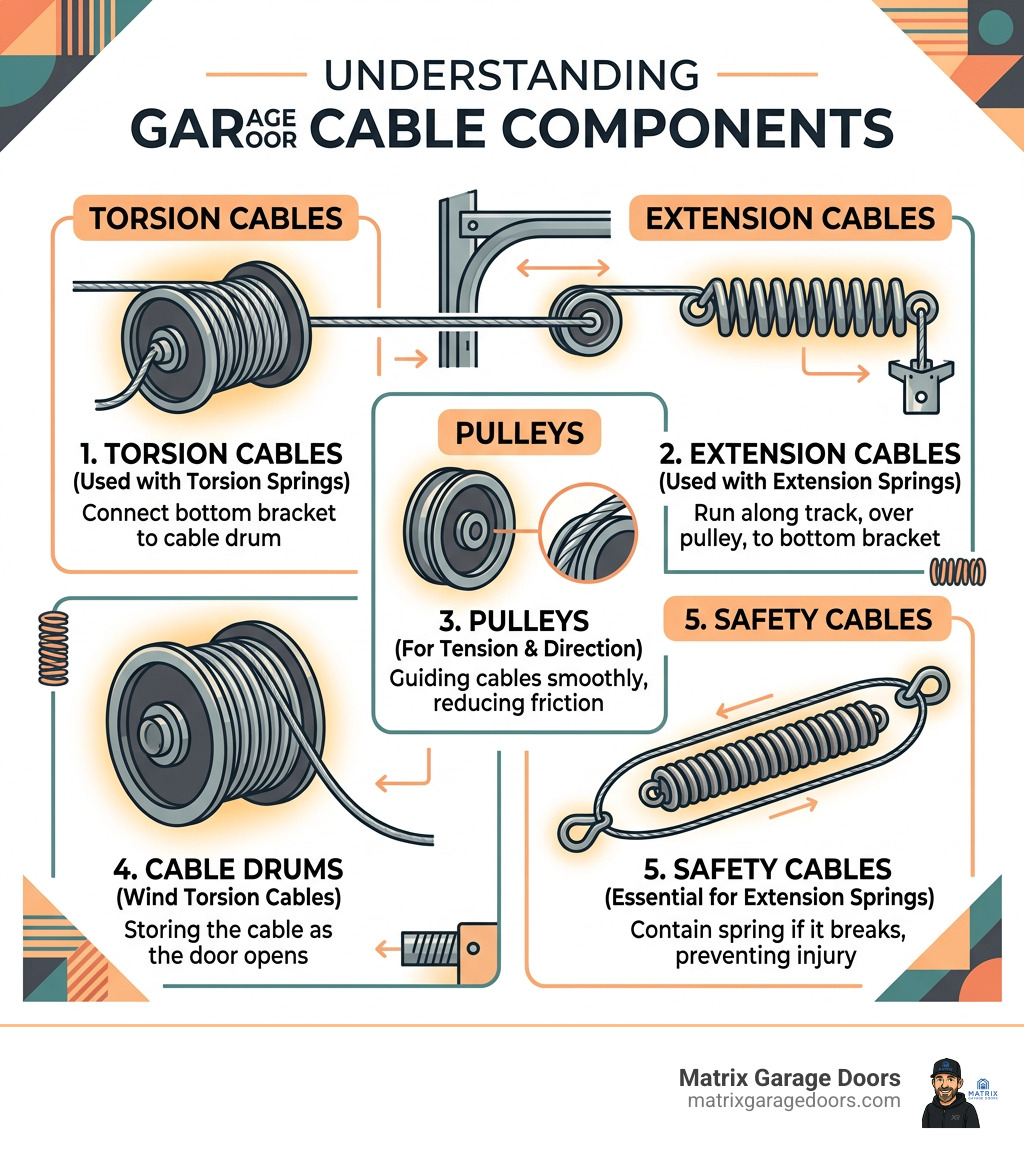
To repair garage door pulley cables effectively, we first need to understand what they actually do. Think of the cables as the “lifting arms” of your garage door. While the springs provide the “muscle” (the tension), the cables are the tendons that connect that power to the door itself. Most cables are made of galvanized steel aircraft cable, which is designed to be incredibly strong yet flexible enough to wind around drums and pulleys thousands of times.
There are three main types of cables you’ll encounter in a residential system:
- Torsion Spring Cables: These are used in systems where the spring is mounted on a shaft above the door. The cables attach to the bottom corners of the door and wind around drums at each end of the shaft.
- Extension Spring Cables: These are found in systems where the springs run horizontally along the tracks. The cables run from the bottom bracket, over a pulley, and connect to the spring.
- Safety Cables: These are specific to extension spring systems. They run through the center of the spring and attach to the track or wall. Their only job is to catch the spring if it snaps, preventing it from flying across the garage like a metal whip.
How to Spot Trouble: The Visual Inspection
We recommend a visual inspection every six months. Look for these “red flags”:
- Fraying: If you see tiny wires sticking out (it might look “shaggy”), the cable is losing its structural integrity.
- Splitting: This is when the cable begins to unravel into separate strands.
- Slackening: If the cable looks loose or sags when the door is closed, it can easily jump off the pulley or drum.
- Corrosion and Rust: Moisture can soften the metal over time, leading to sudden snaps.
| Feature | Torsion Spring Cables | Extension Spring Cables |
|---|---|---|
| Spring Location | Mounted on a bar above the door | Running along the side tracks |
| Lifting Mechanism | Winding drums | Pulley and “S” hooks |
| Durability | High (for heavier doors) | Moderate (standard doors) |
| Safety Risk | High tension on the shaft | High risk of flying springs |
Common Causes of Cable and Pulley Failure
Why do these parts fail in the first place? In our experience serving the Columbus area, from Dublin to Pickerington, we see a few recurring themes:
- Faulty Bearings: Pulleys contain ball bearings. If these seize up or break, the pulley stops spinning. The cable then scrapes against the frozen pulley, creating friction that leads to fraying.
- Door Misalignment: If your tracks aren’t perfectly level, the cable might rub against the hardware or the side of the drum.
- Moisture Damage: Garages are often damp. If the bottom of your door isn’t properly weather-sealed, the bottom brackets and cables sit in puddles, leading to rust.
- Obstructions: If a broom handle or trash can gets caught in the door’s path, the sudden jolt can cause the cable to jump off the pulley or drum.
Essential Tools and Safety for Cable Repair
Before you even think about picking up a wrench to repair garage door pulley cables, you need to gear up. This isn’t just a “handyman” job; it’s a high-tension mechanical repair.
The Tool Kit:
- Vise Grips: Essential for locking the door in place or holding the torsion shaft.
- 7/16-inch Wrench: Most drum set screws and bracket bolts use this size.
- Winding Bars: Only if you have a torsion system. Never use screwdrivers!
- Safety Glasses and Work Gloves: To protect against snapping wires and sharp metal.
Working on these components involves managing extreme kinetic energy. A garage door can weigh anywhere from 100 to over 300 pounds. When a cable is under tension, it is holding that weight. If it snaps or is released improperly, it can cause severe injury.
Before starting, we highly recommend checking out our comprehensive guide on garage door cable repair costs and our ultimate guide to fixing a snapped cable to ensure you have the full picture.
Why DIY Cable Repair Can Be Dangerous
We love a good DIY project as much as anyone, but cables and springs are the “danger zone” of home maintenance. The springs are wound tight with enough energy to lift a heavy steel door. If a cable breaks while you are working on it, the door can slam down instantly. Furthermore, if you are working on a torsion system, the winding bars can kick back with enough force to break bones. If you feel even slightly “out of your depth,” it is much safer to call a professional.
Step-by-Step Guide to Repair Garage Door Pulley Cables
If you’ve decided to proceed with a DIY fix, follow these steps carefully. This guide focuses on the most common scenarios: replacing a worn cable or re-seating one that has slipped.
Replacing Worn or Broken Garage Door Pulley Cables
- Safety First: Unplug the garage door opener. You don’t want anyone hitting the remote while your fingers are near the pulleys.
- Release Tension: For extension springs, open the door fully and secure it with vise grips on the tracks to take the weight off the springs. For torsion springs, you must use winding bars to unwind the spring tension—this is the most dangerous part.
- Remove the Old Cable: Detach the cable from the bottom bracket and then unhook it from the drum or pulley.
- Thread the New Cable: Start at the bottom bracket. Loop the cable over the pulley (for extension systems) or up to the drum (for torsion systems).
- Secure and Wind: Ensure the cable is sitting perfectly in the grooves of the drum or pulley. If it’s a torsion system, tighten the set screws on the drum.
- Adjust and Test: Slowly release the tension. Check that the door is level. You can find more details on how to fix a garage door spring cable or even how to replace the spring if you find that’s the root cause.
How to Fix a Garage Door Cable That Slipped Off
Sometimes the cable hasn’t broken; it has just jumped its tracks. This usually happens because of a loose cable or an obstruction.
- Manual Lifting: You may need to manually lift the door to a level position.
- Vise Grip Placement: Place vise grips under the rollers on both sides to keep the door perfectly level and secure.
- Re-seating the Cable: Loosen the set screws on the cable drum just enough to move it. Guide the cable back into the grooves.
- Groove Alignment: Make sure there are no overlaps or kinks in the cable.
- Tightening: Re-tighten the hardware and test the door manually before reconnecting the opener.
Maintenance Tips and Professional Repair Costs
The best way to repair garage door pulley cables is to prevent them from breaking in the first place. Most cables have a lifespan of about 5 to 7 years. However, with good maintenance, you can push that to the upper limit.
- Lubrication: Every six months, apply a silicone-based lubricant to the pulleys, rollers, and the bottom bracket lip. Do not lubricate the cables themselves, as this can attract dust and grime that causes friction.
- Clear the Path: Ensure the garage door tracks are free of debris. Even a small pebble can cause a “jump” that throws the cable off the pulley.
- Check the Balance: Disconnect your opener and lift the door halfway. If it stays put, it’s balanced. If it falls or shoots up, your tension is wrong, which puts extra strain on the cables.
Understanding the Costs
If you decide to go the DIY route, a pair of cables will generally cost you between $10 and $50. However, if you hire a professional in the Columbus, OH area, you can expect to pay between $100 and $300 for a standard repair. This price usually includes the parts, labor, and a full system safety inspection. If your door is already off its tracks, the cost might be slightly higher due to the complexity of realigning the entire system.
When to Call a Professional for Help
You should put down the tools and call us if:
- The door is visibly crooked or hanging by one cable.
- You hear a loud grinding or scraping sound that doesn’t go away with lubrication.
- The torsion spring is snapped (you’ll see a gap in the coils).
- The door is “stuck” and won’t move even when disengaged from the opener.
For more information, visit our garage door repairs page to see how we can help.
Frequently Asked Questions
Can I repair garage door pulley cables myself?
Yes, if you have moderate mechanical knowledge and the right tools. However, it is inherently risky. Because the cables are under high tension from the springs, a mistake can lead to the door falling or the springs snapping. We always recommend professional service for anything involving the “counterbalance” system (springs and cables).
How much does it cost to fix a snapped cable?
For a professional repair, expect to spend $100–$300. While DIY materials are cheap ($10–$50), the professional fee covers the dangerous task of winding springs and ensuring the door is perfectly balanced, which prevents future repairs.
How often should I inspect my pulleys and cables?
We recommend a bi-annual check (every six months). Look for fraying, rust, or any signs that the cable is “shaggy.” Catching a frayed cable early is much cheaper than repairing a door that has crashed to the floor.
Conclusion
At Matrix Garage Doors, we know that a broken cable can throw your whole day off track—literally. Whether you’re in Bexley, Upper Arlington, or right here in Columbus, a malfunctioning door is a major security and safety risk.
As a family-owned company with over two decades of experience, we pride ourselves on providing prompt, professional service to our neighbors. We offer 24/7 emergency repairs because we know that cables don’t just break between 9 and 5. If you’ve looked at your pulleys and decided that “Cable Chaos” isn’t for you, give us a call. We’ll get your door running smoothly, safely, and quietly.
For more tips or to schedule a service, check out our garage services and repairs page. We’re here to help you keep your home safe and your garage door moving!