From Squeaks to Snaps: A How-To Guide for Garage Door Repairs
Why a Garage Door That Won’t Close Is More Than Just an Inconvenience
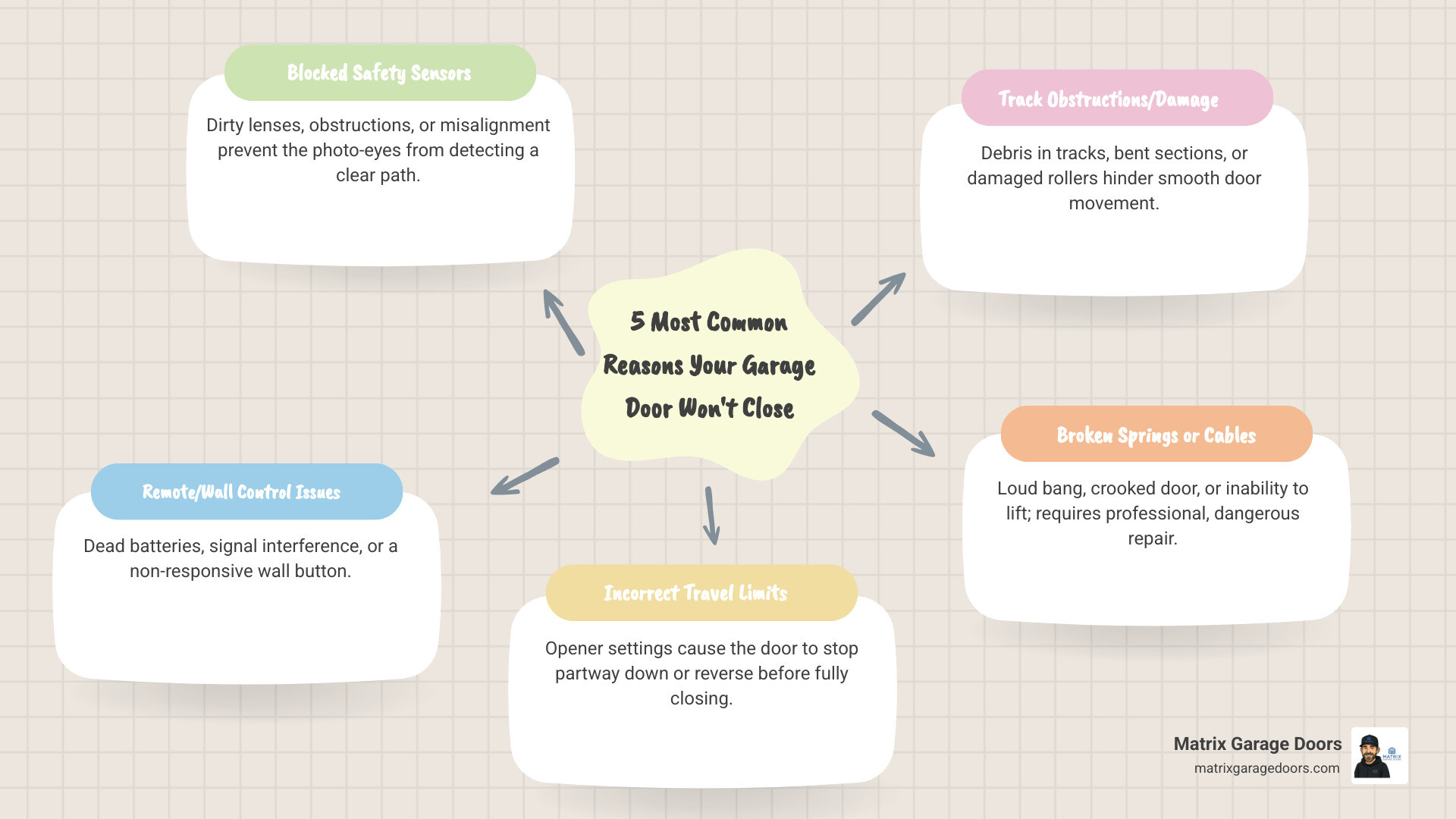
When your garage door won’t close, it’s a security risk and a major inconvenience. The good news is that many closing problems have simple causes you can troubleshoot yourself before calling a professional.
Quick fixes to try first:
- Check for obstructions in the door’s path or blocking the safety sensors.
- Clean and align the photo-eye sensors near the floor.
- Replace the batteries in your remote control.
- Adjust the travel limit screws if the door stops partway down.
- Inspect the tracks and rollers for debris or damage.
Some issues require immediate professional attention, particularly broken springs (often signaled by a loud bang), snapped cables (the door hangs crooked), or an off-track door. These high-tension components are dangerous to repair without specialized tools and training.
This guide will walk you through systematic troubleshooting, from easy fixes to knowing when a problem requires an expert. We’ll cover common issues, manual overrides, and which repairs are safe for DIY versus which need a service call.
I’m Andrew Hopson, and I’ve helped countless Columbus homeowners diagnose and resolve issues when their garage door won’t close. Whether your door reverses on its own or won’t move at all, I’ll show you where to start.
Handy garage door won’t close terms:
- emergency garage door repair columbus ohio
- professional garage door service
- garage door service prices
First-Step Fixes: Simple Checks for a Stubborn Door
When your garage door won’t close, don’t panic. Before calling for help, perform these simple checks that often resolve the most common issues.
First, check for obvious obstructions. A toy, garden tool, or even a pile of leaves can block the door’s path and trigger the safety sensors, preventing it from closing. Take a moment to clear the area completely.
Next, check the power source. Is the opener plugged in? Has a circuit breaker tripped? An unresponsive opener with no lights or sounds often points to a simple power issue.
Finally, examine your remote control and wall button. Dead batteries in the remote are a frequent cause of problems. If the wall button works but the remote doesn’t, you’ve narrowed down the issue.
For more comprehensive tips on keeping your garage door in top shape, check out our Garage Door Maintenance Tips.
What to Do When Your Garage Door Won’t Close and the Light is Blinking
A blinking light on your opener motor usually means there’s an issue with the photo-eye safety sensors. Located about 6 inches from the floor on either side of the door, these sensors project an invisible beam. If the beam is broken, the door will reverse or refuse to close as a safety precaution.
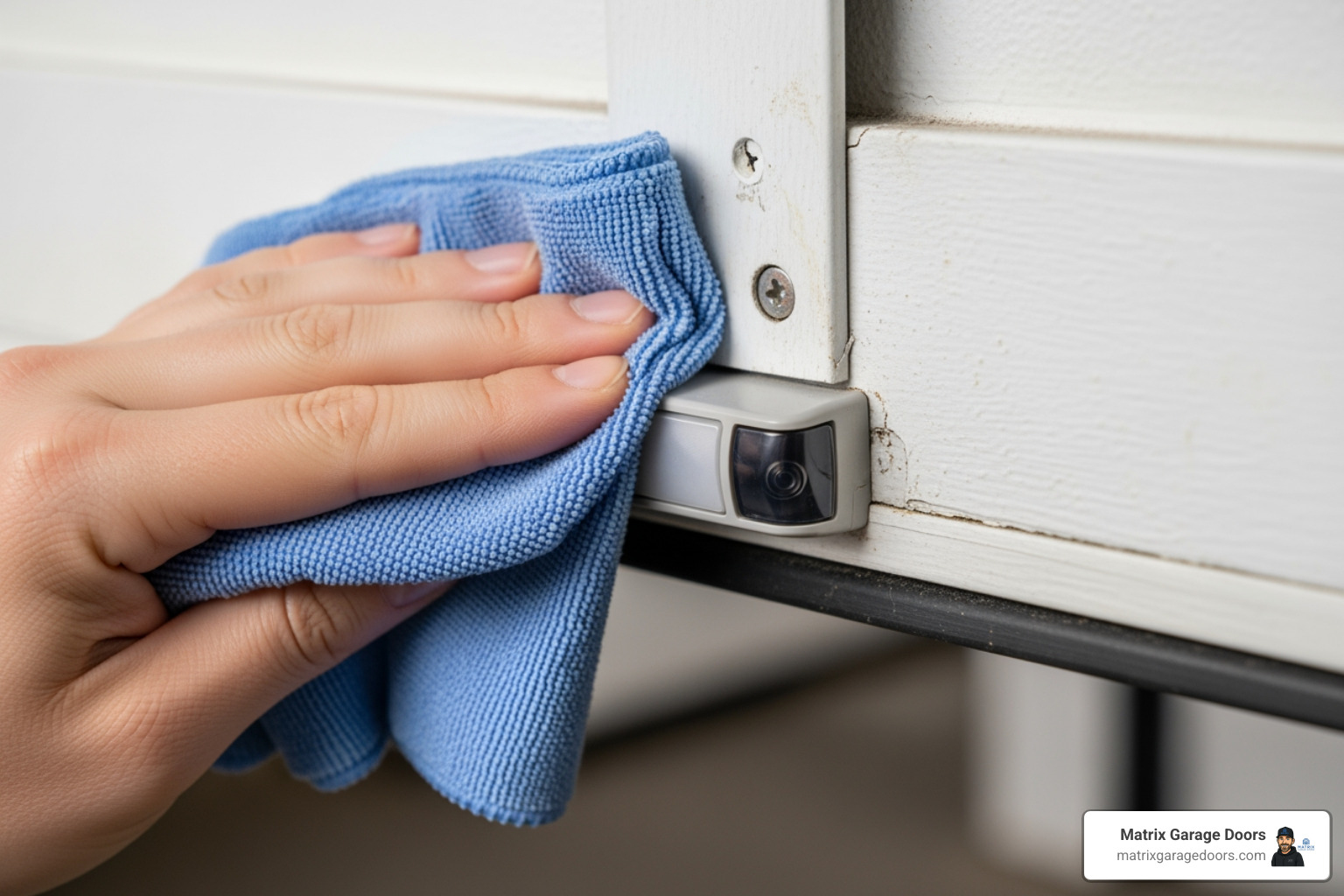
Here’s how to troubleshoot them:
- Check for Obstructions: Remove anything blocking the path between the two sensors, including spiderwebs or debris.
- Clean the Lenses: Gently wipe the sensor lenses with a soft, dry cloth to remove dust and grime.
- Inspect Indicator Lights: Each sensor has an indicator light. Typically, one is solid green (power) and the other is solid yellow or red (aligned). A blinking or off light indicates a problem.
- Align the Sensors: If a light is blinking, the sensors aren’t aligned. Loosen the wingnut on one sensor and gently adjust it until both indicator lights are solid, then tighten it. Repeat if necessary.
- Check Sensor Wiring: Visually inspect the wires running from the sensors to the opener unit for damage. If you see cut or corroded wires, it’s best to call a professional.
Troubleshooting Why Your Garage Door Won’t Close with the Remote
If the wall button works but the remote doesn’t, the problem is likely with the remote or its signal. These are usually easy fixes.
- Replace Remote Batteries: This is the most common culprit. Swap the old batteries for fresh ones.
- Check for Signal Interference: Other electronics, like LED lights or WiFi routers, can interfere with the remote’s signal. Try temporarily turning off nearby devices. Also, ensure the opener’s antenna (a thin wire hanging from the motor) isn’t blocked.
- Reprogram the Remote: A remote can lose its programming after a battery change or power outage. Press the “learn” button on the opener motor unit, then press the button on your remote. The opener light should flash or click to confirm reprogramming. Check your owner’s manual for specific instructions.
- Test the Wall Button: Confirming the wall button works isolates the problem to the remote or signal, as it shows the opener unit has power and is functional.
When Your Garage Door Won’t Close All the Way: Partial Closures and Reversals
Does your garage door stop partway down or reverse after touching the floor? When a garage door won’t close all the way, it usually points to a problem with the opener’s travel limits, door balance, or a physical obstruction.
A reversing door is often a safety feature in action. The opener senses resistance and assumes something is in the way. This can be caused by incorrectly set travel limits or mechanical issues like a bent track or damaged roller creating friction.
For more detailed information on troubleshooting these specific issues, you can refer to our dedicated guide on Garage Door Not Closing.
How to Adjust the Travel Limit Screws
Travel limit screws tell the opener how far the door should move. If they’re misadjusted, your garage door won’t close completely or may reverse after hitting the floor. Adjusting them is a common DIY fix.
Here’s how to do it:
- Locate the Limit Screws: Find the two adjustment screws on your opener unit, usually on the side or back and labeled “Up” and “Down.”
- Identify the “Down” Limit Screw: You’ll be adjusting the “Down” screw, which controls the closed position.
- Make Small Adjustments: Use a flathead screwdriver to turn the “Down” limit screw in quarter-turn increments.
- If the door doesn’t close fully, turn the screw clockwise to increase travel.
- If the door hits the floor and reverses, turn it counter-clockwise to decrease travel.
- Test and Re-adjust: Run the door through a full cycle after each adjustment. The goal is a complete closure where the bottom seal is slightly compressed against the floor. If it slams or reverses, you’ve gone too far.
- Check Force Settings: If limit adjustments don’t work, the force setting might be too sensitive. Consult your manual for adjusting this, but always try travel limits first.
Inspecting for Misaligned Tracks and Damaged Rollers
If sensors and limit settings are fine, the reason your garage door won’t close could be physical. Worn or damaged tracks and rollers can prevent the door from operating smoothly.
Here’s what to look for:
Inspect the Tracks:
- Obstructions: Visually inspect both tracks for debris and remove anything you find.
- Bends or Dents: Look for bent sections. Minor bends can sometimes be gently tapped back with a rubber mallet and wood block, but severe damage requires professional replacement.
- Loose Hardware: Tighten any loose bolts securing the tracks to the wall.
- Alignment: Tracks must be parallel. Misaligned tracks can cause the door to bind and are best fixed by a professional.
Examine the Rollers:
- Wear and Damage: Observe the rollers as the door moves. Look for cracked, worn, or broken rollers that need replacement.
- Lubrication: Apply a silicone-based garage door lubricant to the rollers and bearings. Avoid WD-40, as it attracts dust and can dry out parts.
Manual Overrides and Power Problems
If basic troubleshooting fails, your garage door won’t close because of a power issue or a malfunction requiring you to operate the door manually. Knowing how to handle these situations is key for your home’s security.
When the opener is unresponsive or the power is out, you must know how to close the door by hand to secure your garage. Likewise, it’s important to safely check for simple electrical problems before assuming a major mechanical failure.
For times when your garage door is completely stuck, our guide on Garage Door Stuck Closed offers additional solutions.
How to Manually Close Your Garage Door
When your garage door won’t close due to a power outage or opener failure, you’ll need to close it manually to secure your home.
Here’s a step-by-step guide:
- Locate the Emergency Release Cord: Find the red cord hanging from the trolley on the rail above the door.
- Pull the Cord: Pull the cord down and away from the door to disengage the trolley from the opener’s drive. You should hear a click.
- Safety Note: If the door is open, it may be very heavy and could fall quickly, especially if a spring is broken. Be ready to support its weight. If you suspect a broken spring, wait for a professional.
- Lower the Door by Hand: Grip the bottom of the door and slowly guide it down until it is fully closed.
- Secure the Door: If the opener is broken, lock the door manually. Use the slide lock if it has one, or place a C-clamp on the track just above a roller to prevent it from being opened.
- Re-engage the Trolley: Once power is restored or the opener is fixed, pull the release cord toward the door to re-engage it. You may need to run the opener once to allow the trolley to reconnect automatically.
If the door feels extremely heavy or gets stuck, do not force it. This indicates a serious mechanical issue that needs a professional.
Checking for Power Supply Issues
An unresponsive opener (no lights or sounds) usually indicates a power supply problem. Here’s how to diagnose it.
- Check the Plug: Ensure the opener is securely plugged into its ceiling outlet.
- Test the Outlet: Plug a lamp or phone charger into the same outlet to confirm it has power.
- Check Your Circuit Breaker: Look for a tripped breaker in your home’s electrical panel and reset it. Also, check for a tripped GFCI (Ground Fault Circuit Interrupter) outlet, which is common in garages, and press the reset button.
- Inspect the Power Cord: Look for any visible damage or frayed wires on the opener’s power cord.
If the outlet is dead or the breaker keeps tripping, call a qualified electrician. A repeatedly tripping breaker can signal a serious electrical fault.
Red Flags: When to Stop and Call a Professional
Some garage door problems are too dangerous for DIY repairs. If your garage door won’t close due to a serious mechanical failure, stop and call a professional immediately. Issues involving components under extreme tension, like broken springs, snapped cables, or an off-track door, can cause severe injury or costly damage if handled improperly.
These components are essential for balancing the door’s heavy weight, and their failure requires expert attention. For an idea of service costs, you can consult our Garage Door Service Prices Guide.
Signs of a Broken Spring and Why It’s Dangerous
Garage door springs are the most critical and dangerous parts. They counterbalance the door’s weight, and when one breaks, your garage door won’t close or open and becomes a major safety hazard.
Here are the signs of a broken spring:
- Loud Bang: A sudden, loud noise like a firecracker is the sound of a spring snapping under tension.
- Visible Gap in the Spring: You will see a 2-3 inch gap in the torsion spring above the door.
- Heavy Door: The door will feel extremely heavy and be nearly impossible to lift manually. The opener may strain or fail to lift it.
- Door Hanging Crooked: If one of two extension springs breaks, the door may hang unevenly.
Why is this dangerous? Garage door springs are under hundreds of pounds of tension. Attempting to replace one without proper tools and training can lead to violent, uncontrolled energy release, causing severe injury or even death. Improper handling can also cause further damage to your door system.
Never attempt to fix broken garage door springs yourself. This is a job for trained professionals. If you suspect a broken spring, stop using the door and call us for 24 Hour Garage Door Service.
What to Do for an Off-Track Door or Broken Cables
An off-track door or broken cables are other red flags requiring a professional. If your garage door won’t close and looks crooked, is jammed, or has dangling cables, stop using it immediately.
Look for these signs:
- Uneven or Crooked Door: One side of the door is higher than the other.
- Visible Gaps: You can see gaps between the rollers and the tracks.
- Frayed or Snapped Cables: The lifting cables are visibly damaged or broken. This compromises the door’s support.
- Loud Grinding Noises: These sounds can indicate the door is scraping against the tracks.
Why are these issues dangerous? An unstable door that is off-track or has a broken cable can fall without warning, causing serious injury or property damage. Continuing to operate it will only worsen the damage to tracks, rollers, and the opener.
Do not try to force the door. Disengage the opener and call Matrix Garage Doors. Our technicians can safely realign your door, replace broken cables, and restore your garage to safe working order.
Frequently Asked Questions about Garage Door Closing Issues
Here are answers to common questions we get from Columbus, OH homeowners when their garage door won’t close.
Why does my garage door start to close and then go back up?
This common problem is almost always caused by the safety sensors. The opener thinks something is in the door’s path.
Check the following:
- Obstructions: Look for any objects blocking the beam between the sensors.
- Clean Lenses: Wipe the sensor lenses with a soft cloth.
- Sensor Alignment: Check the small LED lights on both sensors. If one is blinking, they are misaligned and need to be adjusted until both lights are solid.
- Travel Limit Settings: If sensors are fine, the “down” travel limit may be set incorrectly, causing the door to reverse when it touches the floor. A small adjustment may fix this.
How can I secure my garage if the door is stuck open?
A garage door stuck open is a security risk. Here’s how to secure it quickly.
- Manually Close the Door: Pull the red emergency release cord and carefully lower the door by hand. If a spring is broken, the door will be extremely heavy, so use caution.
- Secure from the Inside: Once closed, engage the manual slide lock. If there isn’t one, place a C-clamp on the track just above a roller to prevent the door from being lifted.
- If the Door Won’t Move: If the door is too damaged to close, block the opening from the inside as best you can and call for emergency service immediately. We offer 24 Hour Garage Door Service to secure your home.
What does it mean when the garage door opener motor runs but the door doesn’t move?
This means the opener motor is working but has been disconnected from the door. The most common cause is a disengaged trolley, which connects the opener’s drive to the door arm.
To fix this, you need to re-engage the trolley. Pull the emergency release cord until it clicks back into place. You may need to run the opener once to allow it to automatically reconnect. If this doesn’t work, the opener may have a stripped gear or broken belt/chain, which requires professional repair.
Your Next Step for a Secure, Functioning Garage Door
When your garage door won’t close, it’s a risk to your home’s security and a disruption to your life. Prompt, correct repair is essential for your peace of mind and safety.
While many simple fixes can be done yourself, serious issues with springs, cables, or tracks are jobs for a professional. These repairs require special tools and training to be done safely.
At Matrix Garage Doors, we are a family-owned company with two decades of experience serving Columbus, OH, and surrounding communities, including Bexley, Blacklick, Canal Winchester, Dublin, Etna, Galena, Grandview Heights, Grove City, Groveport, Hilliard, New Albany, Pickerington, Powell, Reynoldsburg, Upper Arlington, Westerville, and Worthington. We offer prompt, professional repairs, installations, and maintenance.
If your garage door won’t close and you’ve tried the DIY fixes, or if you see a dangerous red flag, don’t hesitate to call. Our team is ready 24/7 to provide a reliable solution and guarantee your satisfaction.
Contact us for professional Garage Door Repairs in Columbus, OH today and let us get your garage door back in perfect working order.