Garage door spring replacement: #1 Pro Safety
When a Garage Door Spring Snaps, Your Day Grinds to a Halt
Garage door spring replacement is a critical repair that restores safe, smooth operation to your garage door—and it’s not a job for DIY enthusiasts. Here’s what you need to know:
Quick Answer: Should You Replace Your Garage Door Spring Yourself?
- Never attempt DIY spring replacement – Springs are under extreme tension (300+ lbs) and can cause severe injury or death
- Hire a professional technician – They have specialized tools (winding bars, safety equipment) and training
- Typical cost: $150-$450 – Includes labor, parts, and both springs on double-door systems
- Replacement time: 30-45 minutes – When done by a trained professional
- Springs last 10,000-15,000 cycles – Roughly 7-10 years for average households
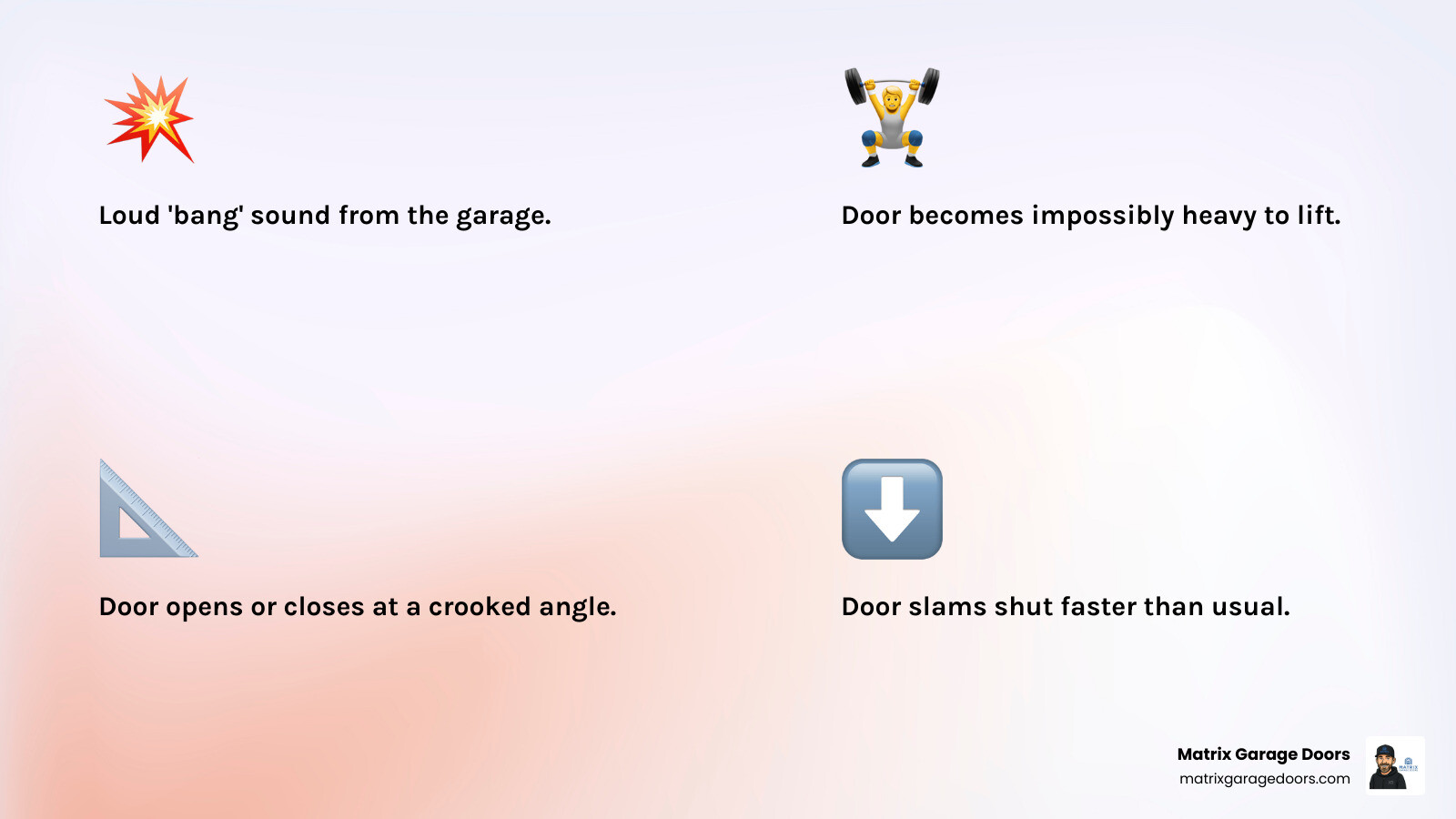
Maybe you heard a loud bang from your garage that sounded like a gunshot. Or perhaps your garage door suddenly became impossibly heavy to lift. You might have even watched your door slam shut faster than usual, or noticed it opening at a crooked angle. These are all telltale signs that your garage door spring has broken.
Your garage door weighs between 150-300 pounds, and the springs are what make it feel light enough to open with one hand. When a spring breaks, that counterbalance system fails—and your door becomes a dangerous, immovable barrier trapping your car inside.
I’m Andrew Hopson, and through my work with Matrix Garage Doors in the Columbus area, I’ve responded to countless emergency calls for Garage door spring replacement, helping homeowners regain safe access to their garages and vehicles. This guide will explain why springs break, how professionals replace them safely, and why attempting this repair yourself could land you in the emergency room.
Essential Garage door spring replacement terms:
- Fix noisy garage door
- Garage door service price
First, The Diagnosis: Is Your Spring Really Broken?
When your garage door starts acting up, it can be frustrating. But before you panic, let’s figure out if a broken spring is truly the culprit. The signs are usually quite dramatic, making diagnosis relatively straightforward. A broken garage door spring isn’t just an inconvenience; it’s a serious safety and security concern. Without the springs counteracting the door’s weight, your garage door becomes an unwieldy, heavy object, posing a risk to anyone nearby and leaving your home vulnerable.
Signs of a Broken Spring
The most common and unmistakable sign of a broken garage door spring is a loud pop or bang that echoes through your garage, often sounding like a gunshot. This is the sound of the spring snapping under immense tension. If you hear this, it’s almost certainly a broken spring.
Beyond the dramatic sound, here are other clear indicators that your spring has given up the ghost:
- Door Won’t Open or is Extremely Heavy: Your garage door feels impossibly heavy to lift manually, or your automatic opener struggles to budge it more than a few inches. This is because the spring, which normally does the heavy lifting, is no longer providing its counterbalance. Operating the door with a broken spring can severely damage your opener and other components.
- Opener Strains or Stops: If your garage door opener is working overtime, making unusual grinding noises, or simply failing to open the door completely, it’s straining against the full weight of the door. This can quickly burn out the opener’s motor.
- Door Slams Shut: Instead of slowly closing, your garage door crashes down with alarming speed. This indicates a complete loss of the spring’s counterbalance, making the door fall under its own considerable weight.
- Uneven Movement or Crooked Door: If your door opens or closes at a strange angle, or appears lopsided, it often means one of the springs in a dual-spring system has broken, leaving the other spring to bear the entire load unevenly. You might also notice loose or detached cables, which are linked to the spring system.
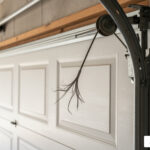
- Visible Gaps in the Spring: For torsion springs, you might see a clear gap in the coiled metal, where the spring has fractured. For extension springs, you might see it visibly stretched out or snapped.
If you observe any of these signs, it’s crucial to stop using your garage door immediately. Continuing to operate it with a broken spring is not only dangerous but can lead to more extensive and costly repairs down the line. For more information about our repair services, visit our Garage Door Repair in Columbus, OH page.
Torsion vs. Extension Springs Explained
Understanding the two main types of garage door springs can help you identify your system and appreciate why professional garage door spring replacement is essential.
Torsion Springs: These are the most common type, especially on modern garage doors. They are mounted horizontally on a metal shaft directly above the garage door opening. Torsion springs work by twisting and coiling to store mechanical energy. When the door closes, the springs wind up, and when the door opens, they unwind, transferring the stored energy to lift the door. Torsion springs are known for their durability and smoother operation. If a torsion spring breaks, it typically stays on the shaft, which acts as a containment system, making it less likely to fly off.
Extension Springs: These springs are typically found on older or lighter garage doors. They are located on either side of the garage door, running parallel to the horizontal tracks. Extension springs work by stretching and contracting. As the door closes, these springs extend, storing energy. When the door opens, they contract, helping to lift the door. While generally more affordable, extension springs tend to wear out faster. A critical safety feature for extension springs is the presence of safety cables. These cables run through the center of each spring and are anchored at both ends. If an extension spring breaks, the safety cable prevents the spring from flying across the garage, potentially causing serious injury or property damage. If your extension springs don’t have these cables, it’s a major safety hazard!
Regardless of the type, both torsion and extension springs are under immense tension, making their repair or replacement a job for trained professionals.
Why Professional Spring Replacement is the Safe Choice
We cannot stress this enough: garage door spring replacement is not a DIY project. While the internet is full of “how-to” guides (and even we’ll touch on the professional process), attempting this repair yourself is incredibly dangerous. We’ve seen the consequences of homeowners trying to tackle this job without the proper training, tools, or understanding of the forces involved.
Garage door springs are under tremendous tension – often hundreds of pounds of force. This stored energy is what makes your heavy garage door feel light. When a spring breaks, or when you attempt to remove or install one, that energy can be released suddenly and violently. This can lead to:
- Severe Injury or Death: A spring snapping or an improper tool slipping can result in broken bones, lacerations, loss of fingers, or even fatal head injuries. The winding bars used for torsion springs, if handled incorrectly, can become deadly projectiles.
- Property Damage: An uncontrolled spring release can cause significant damage to your garage door, your vehicle, walls, or anything else in its path.
- Further Complications: Incorrect spring installation can lead to an unbalanced door, which puts undue stress on your garage door opener, cables, and other hardware, leading to premature wear and even more expensive repairs.
Professionals, like our team at Matrix Garage Doors, have specialized tools, extensive training, and years of experience dealing with these high-tension systems. We know the intricate mechanics of garage doors inside and out, ensuring the job is done safely and correctly the first time. We also carry the necessary insurance, providing you with peace of mind that you’re protected. When you choose professional service, you’re not just paying for a repair; you’re investing in safety, reliability, and expertise.
Whether you’re in Westerville, OH or Hilliard, OH, our professional technicians are ready to assist you safely and efficiently.
The Professional’s Guide to Garage Door Spring Replacement
While we strongly advise against DIY garage door spring replacement, understanding the professional process can give you insight into why it’s a complex task and what to expect when our technicians arrive. Our approach prioritizes safety, precision, and efficiency, ensuring your garage door is back in perfect working order.
Preparation: Gathering the Right Tools and Parts
A professional technician arrives prepared with a full arsenal of specialized tools and the correct replacement parts. This isn’t a job for a standard toolbox. Here’s a glimpse at what’s needed:
- Winding Bars: These are essential for safely tensioning and detensioning torsion springs. They are solid steel rods, typically 1/2 inch in diameter, designed to fit into the winding cones of the springs. Never use screwdrivers or other makeshift tools, as they can slip and cause severe injury.
- C-Clamps or Locking Pliers: Used to secure the garage door to its tracks, preventing it from moving unexpectedly while the springs are being worked on.
- Socket Wrenches and Impact Driver: For quickly and securely loosening and tightening bolts and nuts on brackets and drums.
- Safety Glasses and Leather Gloves: Non-negotiable safety gear to protect against debris, snapping wires, or pinching.
- Correct Replacement Springs: This is crucial. We bring springs that precisely match your door’s specifications (more on this below).
- New Cables: Often, if springs break, cables can be frayed or damaged due to the sudden stress. We’ll inspect and replace them if necessary.
- Bottom Brackets: If they show signs of wear or rust, they’ll also be replaced.
How Professionals Measure for Your Garage Door Spring Replacement
Accurate measurement is paramount for selecting the correct replacement spring. A spring that is too strong or too weak will result in an unbalanced door, leading to premature wear on components and potential safety hazards. Our technicians carefully measure several key aspects:
- Wire Size (Wire Diameter): This is the thickness of the spring wire. We measure 20 coils of the spring and divide by 20, or 40 coils and divide by 40, to get a precise measurement. This is often expressed in fractions of an inch (e.g., 0.250 inches).
- Inside Diameter (ID): This is the inner diameter of the spring coil. Common sizes for torsion springs are 2 inches and 1-3/4 inches.
- Spring Length: The total length of the spring when it’s unwound.
- Wind Direction (Left vs. Right): Torsion springs are wound either left-hand or right-hand. This is determined by observing the direction the end of the spring wire points. Most two-spring systems will have one left-wound and one right-wound spring.
These measurements, along with the weight and height of your garage door, ensure we select the perfect spring to counterbalance your door’s weight. For more in-depth information on the mechanics, you can refer to resources like How to Repair Garage Door Springs and Cables .
The Step-by-Step Professional Replacement Process
While the exact steps vary slightly between torsion and extension spring systems, the core principles of safety and precision remain consistent. Here’s a general overview of how our professionals handle garage door spring replacement:
- Secure the Door and Disconnect Power: The first and most critical step is to ensure the garage door is fully closed and secured with C-clamps or locking pliers to the tracks. We then disconnect the automatic garage door opener from its power source to prevent accidental activation.
- Release Remaining Tension (If Any) and Remove Old Springs: For torsion springs, any remaining tension is carefully released using winding bars. The winding cones and stationary cones are loosened, and the old, broken springs are removed from the torsion shaft. For extension springs, if they haven’t already snapped completely, they are carefully detached.
- Inspect and Replace Cables and Hardware: We thoroughly inspect the lift cables, pulleys, and bottom brackets. If any show signs of wear, fraying, or damage, they are replaced to ensure the entire system functions optimally and safely.
- Install New Springs: The new springs, precisely matched to your door’s specifications, are carefully slid onto the torsion shaft (for torsion systems) or attached to their respective mounting points (for extension systems).
- Wind New Springs (Torsion Systems): This is where expertise is vital. Using specialized winding bars, our technicians carefully apply the correct number of turns to the new torsion springs. This precise winding is what creates the stored energy needed to lift your door. For a typical 7-foot tall door, this usually involves 30 quarter turns, and 36 for an 8-foot door.
- Test Door Balance and Adjust: Once the springs are installed and tensioned, we carefully remove the clamps and reconnect power to the opener. We then manually lift the door to about waist height. A perfectly balanced door should stay in place at this position without falling or rising. If it doesn’t, fine-tune adjustments are made to the spring tension until the door is perfectly balanced. This ensures smooth, effortless operation and prevents premature wear on the opener.
Why Both Springs Are Replaced: On a double garage door system (which typically has two torsion springs), if one spring breaks, we always recommend replacing both. Here’s why: if they were installed at the same time, the second spring has experienced the same amount of wear and tear and is likely nearing the end of its lifespan. Replacing both at once ensures balanced operation, prevents another service call soon after, and ultimately saves you money and hassle in the long run.
For professional and reliable garage door spring replacement services in your area, including Dublin, OH, don’t hesitate to reach out to us.
Understanding Costs, Lifespan, and Maintenance
Dealing with a broken garage door spring inevitably brings up questions about cost, how long springs should last, and what you can do to prevent future issues. We believe in transparency and empowering our customers with knowledge.
What’s the Typical Cost and Lifespan?
The cost of professional garage door spring replacement can vary depending on several factors, including the type of spring (torsion vs. extension), the weight and size of your door, and labor rates. In the Columbus, OH area, you can generally expect to pay between $150 and $450 for a professional spring replacement, which often includes parts and labor for both springs on a double-door system. For a single torsion spring, the cost might be around $250. That emergency service or additional repairs (like replacing damaged cables or drums) could impact the final price.
Regarding lifespan, most garage door springs are designed to last for a specific number of cycles, where one cycle equals one opening and one closing of the door. Standard springs are typically rated for 10,000 to 15,000 cycles. For an average household that opens and closes their garage door 3-5 times a day, this translates to about 7 to 10 years of reliable operation.
However, factors like:
- Frequency of Use: High-traffic garages will wear out springs faster.
- Climate: Cold winters can make springs more brittle and prone to breaking.
- Maintenance: Lack of lubrication can lead to friction and premature wear.
- Spring Quality: Higher-quality springs, sometimes rated for 25,000 or even 30,000 cycles, can last significantly longer, though they may have a higher upfront cost.
How to Extend the Life of Your New Springs
Once you’ve had your garage door springs replaced by professionals, there are simple maintenance steps you can take to help them last as long as possible:
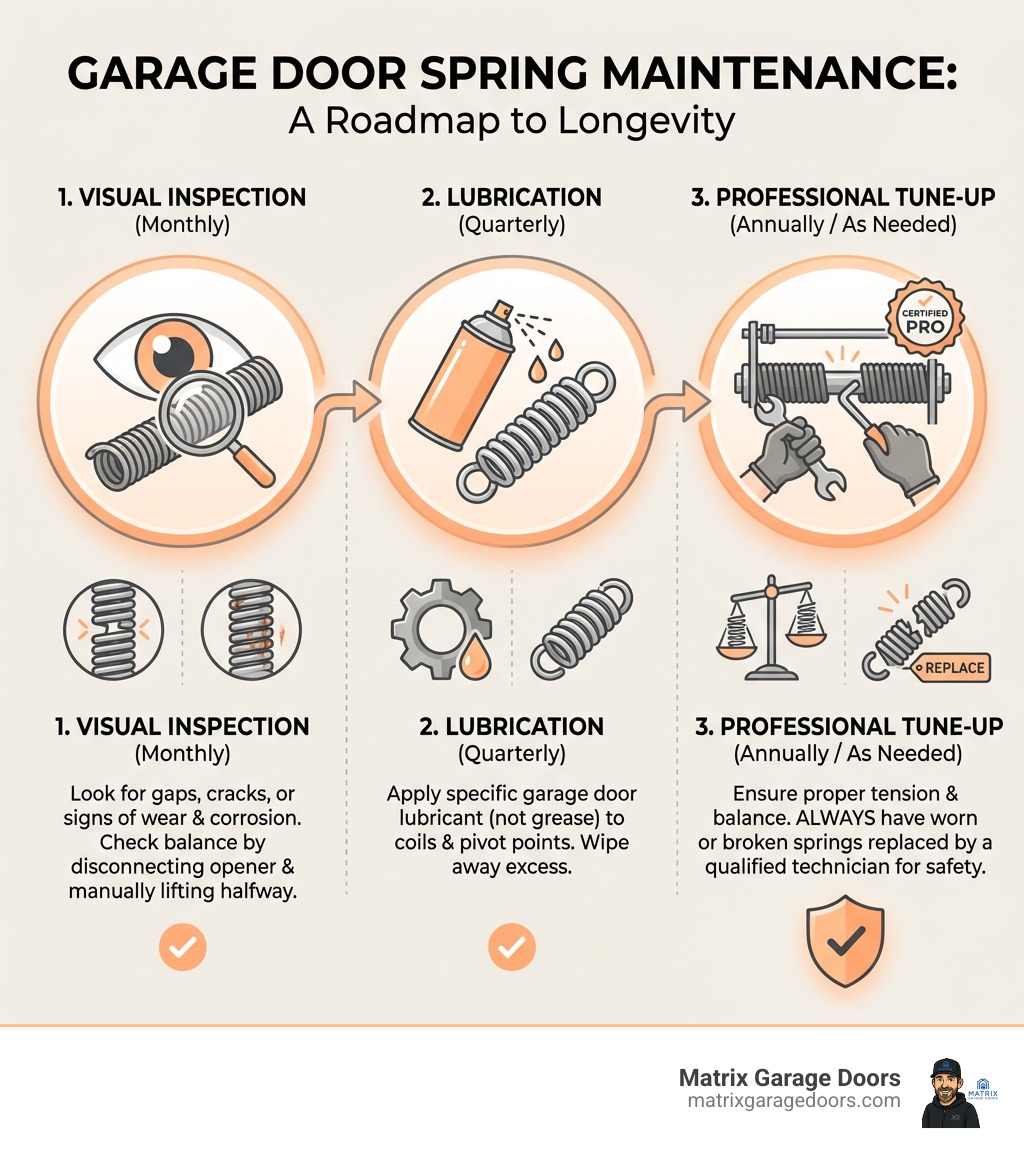
- Regular Lubrication: We recommend lubricating your garage door springs (and other moving metal parts like rollers and hinges) at least once a year, or every 3-6 months if your door sees heavy use. Use a silicone-based or lithium-based lubricant. Avoid water-based products like WD-40, as they can attract dirt and actually cause more problems over time. Lubrication reduces friction and prevents rust, which are major contributors to spring failure.
- Annual Inspection and Tune-Up: Schedule a professional annual inspection for your entire garage door system. During this tune-up, our technicians will not only lubricate components but also check the door’s balance, tighten loose hardware, and inspect for any early signs of wear or potential issues. This proactive approach can catch problems before they become major repairs.
- Test Door Balance Periodically: Every few months, disconnect your garage door opener (pull the emergency release cord) and manually lift the door halfway. If it stays in place without falling or rising, your springs are properly balanced. If it moves, it’s a sign that your springs might need adjustment or are weakening, and it’s time to call a professional.
By following these simple maintenance tips, you can significantly extend the life of your garage door springs and ensure your system operates smoothly and safely for years to come. For more comprehensive advice, check out our Garage Door Maintenance Tips.
Frequently Asked Questions about Garage Door Spring Replacement
We often get asked similar questions about garage door spring replacement, and for good reason—it’s a critical component of your home. Here are some of the most common inquiries we receive:
Should both springs be replaced on a double garage door?
Yes, absolutely. For double garage doors, which typically operate with two torsion springs, if one spring breaks, we always recommend replacing both springs simultaneously. Here’s why:
- Shared Lifespan: Both springs were likely installed at the same time and have endured the same amount of wear and tear and cycles. If one has failed, the other is undoubtedly fatigued and nearing the end of its operational life.
- Ensures Balance: Replacing both springs ensures that your garage door is perfectly balanced. If you only replace one, the new spring will be stronger than the old, weakened one, leading to uneven lifting, strain on your opener, and potential damage to the door itself.
- Prevents Future Service Calls & Saves Money: Replacing both springs at once avoids the inconvenience and cost of another service call when the second spring inevitably breaks shortly after the first. It’s a proactive approach that saves you time and money in the long run.
For single garage doors, it’s generally not critical to replace the spring on another, separate single garage door if one breaks, as their usage might differ significantly. However, for a single door with a dual spring system (less common but does exist), the “replace both” rule still applies.
What are the main risks of DIY garage door spring replacement?
The risks associated with attempting DIY garage door spring replacement are severe and cannot be overstated. We strongly advise against it due to the inherent dangers:
- Extreme Tension Release: Garage door springs are under immense tension, often holding back hundreds of pounds of force. If this tension is released improperly or accidentally, the spring can snap, whip around violently, or send components flying, causing severe lacerations, broken bones, head trauma, or even death.
- Incorrect Tools & Slipping: Using improper tools (like screwdrivers instead of dedicated winding bars) can lead to tools slipping, causing injury to yourself or damage to the garage door system.
- Improper Winding: Incorrectly winding the springs can result in an unbalanced door, which strains the opener, causes jerky movement, or leads to the door falling unexpectedly. This also significantly shortens the lifespan of the new springs and other components.
- Door Falling: If the door is not properly secured during the process, or if the springs are installed incorrectly, the heavy door can fall suddenly, crushing anything or anyone beneath it.
Given these significant risks, this is one home repair project that should always be entrusted to a trained and experienced professional.
How long do garage door springs typically last?
Garage door springs are designed for durability, but they do have a finite lifespan. Typically, they are rated for 10,000 to 15,000 cycles. A cycle refers to one complete opening and closing of the garage door.
For an average household in the Columbus, OH area, where the garage door is typically used 3-5 times a day, this translates to an average lifespan of about 7 to 10 years.
However, several factors can influence how long your springs actually last:
- Usage Frequency: The more you use your garage door, the faster the springs will accumulate cycles and wear out.
- Climate: In regions with significant temperature fluctuations, like Ohio, cold winters can make spring steel more brittle, potentially leading to premature breakage.
- Maintenance: Regular lubrication and professional tune-ups can significantly extend the life of your springs by reducing friction and preventing rust. Lack of maintenance will shorten their lifespan.
- Spring Quality: Higher-quality springs, sometimes referred to as “high-cycle” springs, are manufactured to withstand more cycles (e.g., 25,000 or 30,000 cycles) and will naturally last longer than standard springs.
- Door Weight: Heavier garage doors put more stress on the springs, potentially shortening their life if the springs are not correctly rated for the door’s weight.
While 7-10 years is a good guideline, it’s always wise to be aware of the signs of a failing spring and to have them inspected regularly by a professional.
Conclusion: Trust the Professionals for a Safe Repair
Dealing with a broken garage door spring can be a major headache, disrupting your daily routine and posing significant safety risks. We’ve seen the “broken spring blues” countless times in our two decades of service across the Columbus area, from Bexley, OH to Worthington, OH.
The bottom line is clear: garage door spring replacement is a complex and dangerous task that demands professional expertise. The extreme tension, specialized tools, and precise measurements involved mean that attempting a DIY repair can lead to severe injury, costly property damage, and an improperly functioning garage door. Your safety, and the longevity of your garage door system, are simply not worth risking.
At Matrix Garage Doors, we’re a family-owned company dedicated to providing prompt, professional, and safe garage door repair services throughout Central Ohio. Our experienced technicians are equipped to handle all types of garage door spring replacements, ensuring your door operates smoothly and securely. We even offer 24/7 emergency residential garage door repair, because we know these things never happen at a convenient time.
Don’t let a broken spring keep you trapped or compromise your home’s security. When your garage door spring snaps, trust the professionals.
Contact us for professional garage door repairs today, and let us bring peace of mind back to your garage.