Safely Swap Your Garage Door Springs and Save a Bundle
Why Garage Door Springs Are Worth Understanding (and When to Replace Them)
To change out garage door springs is a task that can save you $200-$300 in labor, but it’s also one of the most dangerous DIY home repairs. Here’s what you need to know:
Quick Answer:
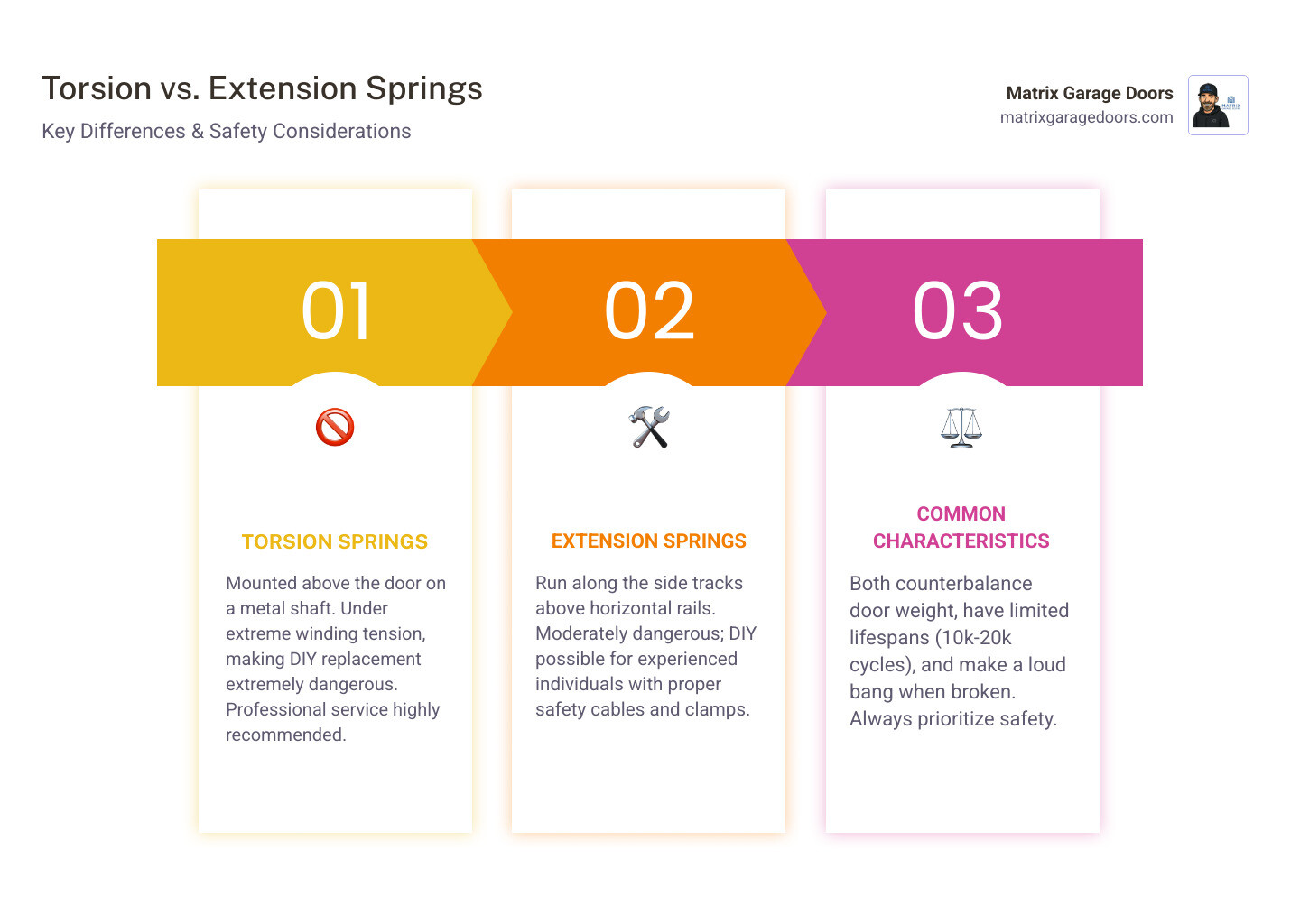
- Extension Springs (along tracks): Moderately dangerous; possible for experienced DIYers with proper safety gear.
- Torsion Springs (above door): Extremely dangerous due to high tension; professional replacement is strongly recommended.
- Cost Savings: DIY parts cost $40-$120 vs. professional service at $150-$350.
- Safety First: Springs are under tremendous tension and can cause severe injury or death if mishandled.
Garage door springs do the heavy lifting, counterbalancing the door’s 200-300 pound weight so it can be lifted with minimal force. They have a limited lifespan, typically 10,000 to 20,000 open/close cycles.
When a spring breaks, you’ll often hear a loud gunshot sound from the garage. The door may become impossible to open, close too fast, or hang crooked. Your automatic opener will likely strain or stop working due to safety features.
While the average professional replacement costs $200-$300, the DIY route is risky. Torsion springs are under extreme tension and have caused severe injuries to many DIYers. Even extension springs require careful handling.
I’m Andrew Hopson of Matrix Garage Doors. I’ve seen the aftermath of failed DIY attempts, which is why I stress proper technique and knowing when to call a pro to change out garage door springs. This guide will help you decide if this repair is for you or if it’s time for professional help.
Basic change out garage door springs vocab:
Before You Start: Safety, Tools, and Spring Identification

Before you change out garage door springs, you must understand the safety risks, required tools, and how to identify your springs. Preparation is paramount.
Signs of a Broken or Failing Spring
- Loud Snapping Noise: Often described as a “gunshot,” this is the unmistakable sound of a spring breaking.
- Door Won’t Lift: The door feels incredibly heavy to lift manually, or the opener strains and stops after a few inches.
- Uneven or Crooked Door: The door hangs unevenly, as the remaining spring can’t support the full weight.
- Door Closes Too Quickly: A weakened spring can cause the door to slam shut, creating a hazard.
- Visible Gaps or Damage: You can see a clear break in a torsion spring’s coil or a gap in an extension spring.
- Slack Cables: Loose or detached cables are a common symptom of a broken spring that is no longer providing tension.
Safety Precautions: Your #1 Priority
Garage door springs are under immense tension and can cause severe injury or death. Safety is not optional.
- Disconnect the Opener: Always unplug the garage door opener to prevent accidental activation.
- Secure the Door: Use C-clamps or locking pliers to clamp the door shut (for torsion springs) or open (for extension springs) to the track. Never work on springs with an unsecured door.
- Wear Proper PPE: Heavy-duty work gloves and safety glasses are mandatory.
- Use the Right Tools: Never improvise. Use only proper winding bars for torsion springs; screwdrivers or wrenches are extremely dangerous substitutes.
- Clear the Area: Keep children and pets away from the garage while you work.
Essential Tools and Parts
Having the right tools is critical for safety and success.
- Winding Bars (for Torsion Springs): Non-negotiable. Two 18-inch bars that fit your winding cones. Buy garage door winding bars at Amazon.
- C-Clamps or Locking Pliers: To secure the door.
- Wrench or Socket Set: For bolts and setscrews (7/16″, 1/2″, 9/16″ are common).
- Tape Measure & Wire Gauge/Calipers: For accurate spring measurements.
- Safety Glasses and Heavy-Duty Gloves: Mandatory PPE.
- Sturdy Ladder, Mallet, Marker, and Lubricant.
- Replacement Springs: The correct type and size are vital. Buy garage door springs at Amazon.
- Optional: New cables, pulleys, and bearings.
Measuring and Identifying Replacement Springs
Using the wrong spring is dangerous and will cause system failure.
- Extension Springs: Run parallel to the horizontal tracks. They stretch to store energy and are often color-coded by weight capacity. They must have a safety cable running through them.
- Torsion Springs: Mounted on a shaft above the door opening. They store energy by twisting.
To get the correct replacement, you need four measurements from the old spring:
- Wire Size (Gauge): Measure 20 coils, then divide that length by 20. A caliper is more accurate.
- Inside Diameter: The inner diameter of the coils (e.g., 1 3/4″, 2″).
- Length: The total length of the spring when unwound.
- Wind Direction (Torsion only): Look at the end of the spring wire. The direction it points (left or right) indicates a left-wound or right-wound spring.
Always replace with the exact same size. If you’re unsure, consult a professional. Using the wrong spring creates an unbalanced, hazardous door that will strain your opener.
| Aspect | DIY Replacement (Parts Only) | Professional Replacement (Parts & Labor) |
|---|---|---|
| Estimated Cost | $40 – $120 | $150 – $350 |
| Time Investment | 1 – 3 hours (Advanced DIY) | 1 – 2 hours |
| Skill Level Required | Advanced | Expert |
| Safety Risk | High | Low (for homeowner) |
| Tools Needed | Specialized + Common | Specialized (provided by pro) |
| Guarantee/Warranty | None | Often provided |
For more cost insights, see our guide on Garage Door Spring Replacement and Repair Costs.
When to Call a Professional Instead
We strongly recommend calling a professional if:
- You have Torsion Springs: The risk of injury is extremely high. Don’t attempt this without extensive mechanical experience.
- You lack the proper tools: Especially winding bars for torsion springs.
- Your system is specialized: Low headroom, EZ-Set, or Torque-Master systems require special procedures.
- You are unsure at any point: Your safety is worth more than any potential savings.
- You want a guarantee: Professionals offer warranties on parts and labor.
At Matrix Garage Doors, we offer comprehensive Garage Door Services and Repairs in Columbus, OH, and surrounding areas, including Bexley, Blacklick, Dublin, Etna, Galena, Grandview Heights, Grove City, Groveport, Hilliard, New Albany, Pickerington, Powell, Reynoldsburg, Upper Arlington, Westerville, and Worthington.
How to Replace Extension Garage Door Springs
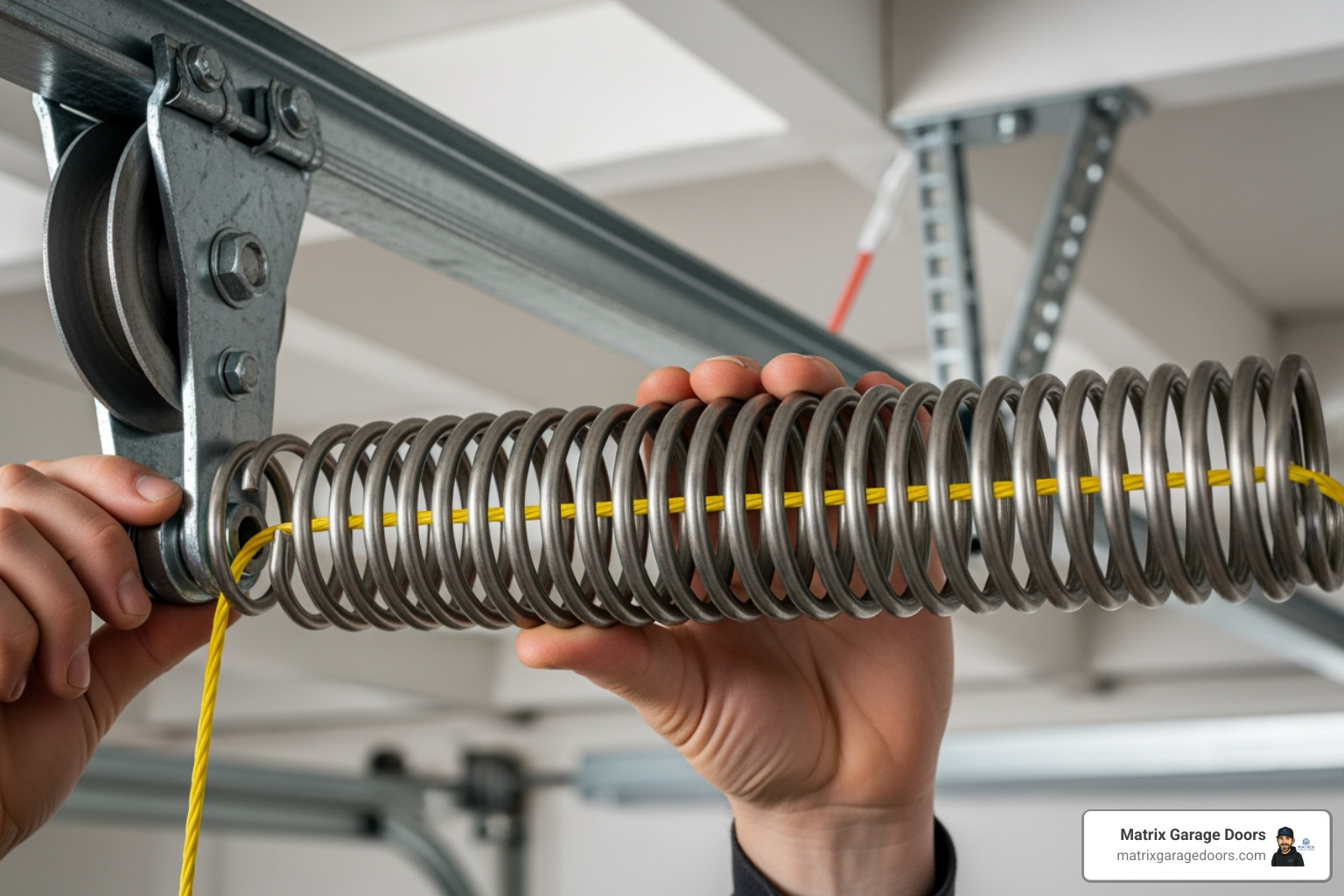
Replacing extension springs is less dangerous than torsion springs but still requires extreme caution. These springs stretch along the horizontal tracks and are typically found on older or lighter doors. The process involves relieving tension, removing the old spring, and installing the new one with a safety cable. This task is approachable for an experienced DIYer who follows all safety measures. A broken spring can also damage cables; learn more in our article on Fix Garage Door Spring Cable.
Step-by-Step: How to Change Out Garage Door Springs (Extension Type)
We recommend replacing both springs for balanced operation.
Prepare the Door:
- Open the garage door fully to remove spring tension.
- Secure the open door by clamping C-clamps on both vertical tracks below the lowest roller.
- Unplug the garage door opener to prevent accidental activation.
Disconnect the Old Spring:
- Mark the pulley’s current location on the track.
- Unbolt the spring from the track bracket.
- Disconnect the lift cable from the door rail bracket.
- Unthread the cable from the movable pulley at the end of the spring.
Remove Old Spring and Safety Cable:
- Disconnect the safety cable (if present) from the track bracket.
- Remove the old extension spring. If there was no safety cable, you must add one now.
Install New Spring and Safety Cable:
- Thread a new safety cable through the new extension spring. This is a vital safety feature.
- Secure one end of the safety cable to the track bracket.
- Attach one end of the new spring to the track and the other end to the movable pulley.
Reconnect Pulleys and Cables:
- Reroute the lift cable from the bottom door bracket, over the stationary pulley, through the movable pulley, and back to the track bracket.
- Reinstall the pulley at the marked location.
- Stretch the new spring slightly (1-2 inches) when attaching the cable to ensure proper tension.
- Repeat all steps for the other side.
Final Test:
- Ensure all connections are secure.
- Remove the C-clamps.
- Reconnect power to the opener and test the door’s balance. It should hold its position when lifted halfway. If not, adjustments may be needed.
How to Change Out Garage Door Springs (Torsion System)
Replacing torsion garage door springs is the most dangerous DIY garage door repair. These springs are under immense, tightly wound tension, and if mishandled, they can release that energy with explosive force, causing severe injury or worse. We strongly recommend that homeowners, especially those without extensive mechanical experience, hire a professional for this task. The cost savings are often not worth the risk.
However, for the advanced DIYer who understands the extreme danger and commits to meticulous safety protocols, we will outline the process for how to change out garage door springs (torsion type). Always remember to use proper winding bars and never take your eyes off the springs or your hands off the winding bars during the winding/unwinding process. For a deeper dive into torsion spring specifics, you can also refer to our guide on How to Replace Garage Door Torsion Springs.
Step-by-Step: How to Change Out Garage Door Springs (Torsion Type)
This process is complex and requires absolute focus and adherence to safety. If you are struggling at any point, always contact a professional garage door technician for assistance.
Lock the Door Down and Disconnect Power:
- Lower the garage door completely to the closed position.
- Secure the door to the track with C-clamps or locking pliers on both sides, preventing it from moving up.
- Unplug Opener: Unplug your garage door opener from the power outlet. Disengage the opener from the door by pulling the emergency release cord.
Prepare for Unwinding:
- Locate the winding cone at the end of the torsion spring (the side closest to the center bracket).
- Insert one winding bar firmly into one of the holes in the winding cone. Keep a firm grip on this bar.
- Loosen the setscrews on the winding cone with your adjustable wrench or socket. Keep one winding bar in place to hold the spring’s tension.
- Extreme Caution: The spring will try to unwind. Maintain a firm, controlled grip on the winding bar.
Unwind the Broken Spring (and the other one):
- With one winding bar holding tension, insert the second winding bar into the next available hole.
- Slowly and carefully remove the first bar, allowing the spring to unwind by a quarter turn. Reinsert the first bar into the next hole and remove the second. Repeat this process, alternating bars, gradually unwinding the spring a quarter turn at a time. Count each quarter turn as you go. For a 7-foot door, you’ll typically unwind about 7 1/2 turns (30 quarter turns); for an 8-foot door, about 8 1/2 turns (34 quarter turns).
- Once the spring is fully unwound, loosen the bolts connecting the stationary cone to the center bracket.
- Repeat this unwinding process for the other spring on the torsion shaft, even if it’s not broken.
Remove Old Hardware and Springs:
- Loosen the setscrews on the cable drums at both ends of the torsion bar.
- Disconnect the lift cables from the cable drums and from the bottom door brackets.
- Slide the cable drums off the torsion bar.
- Hold the torsion bar in place with locking pliers near the end bearing plate to prevent it from falling.
- Slide the old springs, center bearing (if applicable), and end bearings off the torsion bar.
Install New Springs:
- Slide the new torsion springs onto the torsion bar. Ensure you have the correct left-wound and right-wound springs positioned correctly (e.g., right-wound spring on the left side, left-wound spring on the right side, with the winding cones facing the center bracket).
- Bolt the stationary cones of the new springs to the center mounting bracket.
- Reinstall the center bearing if you removed it.
- Slide the cable drums back onto the torsion bar, ensuring they are flush against the end bearing races.
Reattach Lift Cables and Tighten Drums:
- Reattach the lift cables to the bottom door brackets.
- Thread the lift cables onto the cable drums, ensuring they are properly seated in the grooves.
- Pull the cables taut and then tighten the setscrews on the cable drums. Ensure the cables have equal tension on both sides.
Wind the New Springs:
- This is the most critical and dangerous step. Insert a winding bar into the winding cone.
- Using both winding bars, twist the winding cone and torsion spring upwards, applying the precise number of quarter turns you previously noted (or 30 for a 7-foot door, 34-36 for an 8-foot door).
- Keep one bar firmly inserted while you move the other. Always maintain control.
- Once wound, tap the side of the winding bar with a hammer to stretch the spring about 1/4 inch. This prevents binding.
- Tighten the setscrews on the winding cone firmly (about 1/2 to 3/4 turn after finger-tight).
- Repeat for the other spring.
Lubricate and Test:
- Apply a silicone-based or garage door specific spray lubricant to the new torsion springs (avoiding the last inch near the cones).
- Remove all clamps from the garage door.
- Plug the opener back in and re-engage it with the door.
- Test the door’s balance and operation by manually lifting it about 3 feet. It should stay in place. If it doesn’t, you’ll need to adjust the spring tension (add or remove quarter turns) until it is perfectly balanced.
After the Replacement: Testing and Maintenance
Once you’ve successfully managed to change out garage door springs, whether extension or torsion, your job isn’t quite done. Proper testing and ongoing maintenance are crucial to ensure safety, optimal performance, and to prolong the lifespan of your new springs.
Test the Balance and Functionality
A properly balanced garage door should feel almost weightless. Here’s how we test for proper balance and functionality:
- Disconnect the Opener: Unplug your garage door opener and manually disengage it from the door.
- Lift Manually: Lift the garage door about halfway up (around 3 feet).
- Release: Carefully let go of the door.
- Perfect Balance: The door should stay put, neither rising nor falling. This indicates the springs are correctly tensioned for the door’s weight.
- Door Falls: If the door falls or is difficult to hold in place, the springs are too weak or need more tension. Add a quarter turn to each torsion spring, or adjust the attachment point for extension springs to increase tension.
- Door Rises: If the door springs up on its own, the springs are too strong or have too much tension. Release a quarter turn from each torsion spring, or adjust the attachment point for extension springs to decrease tension.
- Full Cycle Test: Once balanced, open and close the door manually a few times, then reconnect your opener and test it with the opener. Ensure smooth operation throughout the entire range of motion.
Lubrication and Recommended Maintenance
Regular maintenance is key to extending the life of your garage door springs and preventing future issues.
- Lubrication: We recommend lubricating your garage door springs every 3-6 months. Use a silicone-based lubricant or a garage door specific spray lubricant. Apply it generously to the coils of the springs. Avoid using WD-40, as it’s a degreaser and can attract dirt. Lubrication helps reduce friction, prevents rust, and ensures smoother operation.
- Check Cables and Pulleys: While you’re lubricating, take a moment to inspect your lift cables for any signs of fraying or wear. Check pulleys (especially for extension springs) for any damage or sticking. These components work hand-in-hand with your springs, and their failure can impact spring performance.
- Visual Inspection: Make it a habit to visually inspect your springs monthly for any signs of wear, rust, corrosion, or loose connections. Early detection of issues can prevent a complete spring failure.
- Professional Check-ups: Consider an annual professional inspection. Our technicians at Matrix Garage Doors can identify subtle signs of wear, adjust tension, and lubricate components, ensuring your system remains in top shape.
For more detailed maintenance tips, explore our guides on The Ultimate Guide to Preventative Garage Door Care and Garage Door Maintenance Tips.
Frequently Asked Questions about Spring Replacement
We often get questions about garage door springs. Here are some of the most common ones we hear, especially when homeowners are considering how to change out garage door springs.
How long do garage door springs last?
Most garage door springs are designed to last for a specific number of cycles, with one cycle being one complete opening and closing of the door.
- Standard torsion springs typically have a service life of 7,000 to 10,000 open/close cycles.
- Double-life torsion springs can last significantly longer, up to 25,000 cycles.
- Most garage door springs should last between 10,000 and 20,000 cycles of opening and closing when properly installed.
Several factors can affect their lifespan:
- Usage Frequency: The more you open and close your garage door, the faster the springs will wear out. A door opened four or five times a day will reach its cycle limit faster than one opened only once.
- Maintenance: Regular lubrication and inspection can prolong spring life by reducing friction and preventing rust.
- Climate: Extreme temperatures and humidity (especially in areas like Columbus, OH) can contribute to rust and corrosion, shortening a spring’s lifespan.
- Spring Quality: High-quality springs made from durable materials will naturally last longer.
- Proper Installation and Balance: Incorrectly installed or unbalanced springs will wear out faster due to uneven stress.
Can I replace just one spring?
While it might seem logical to replace only the broken spring, we strongly advise against it. When one spring breaks, the other spring (if you have two) has likely endured the same amount of wear and tear, usage cycles, and environmental exposure. It’s probably not far behind in terms of lifespan.
Replacing both springs at the same time ensures:
- Balanced System: Your garage door will be properly balanced, with both springs providing equal lifting force. This prevents uneven wear on other components, like cables, drums, and your opener.
- Consistent Lifespan: You won’t have to worry about the other spring breaking shortly after, forcing you to repeat the entire process.
- Long-Term Reliability: A fully refreshed spring system will operate more smoothly and reliably for a longer period.
Think of it like replacing tires on a car; you usually replace them in pairs for optimal performance and safety. For more information on replacing springs, visit our page on Replace Garage Door Spring.
What happens if I use the wrong size spring?
Using the wrong type or size of garage door spring can lead to a host of problems and safety hazards:
- Improper Balance: The most immediate consequence is an unbalanced door. If the spring is too weak, the door will feel extremely heavy, making it difficult to open and potentially slamming shut. If the spring is too strong, the door might fly open too quickly, making it hard to close and creating a dangerous projectile.
- Strain on Opener Motor: An unbalanced door puts immense strain on your garage door opener’s motor. This can lead to premature wear and tear, costly repairs, or even complete failure of the opener.
- Safety Hazard: An unbalanced door is a significant safety risk. It can fall unexpectedly, pinch fingers, or cause serious injury. If the door closes too quickly, it can cause damage to property or harm to people or pets caught underneath.
- Reduced Lifespan of Components: The entire garage door system is designed to work in harmony. An incorrect spring size will cause uneven stress on cables, rollers, tracks, and hinges, leading to faster wear and tear and more frequent repairs.
- Poor Performance: The door may not open or close smoothly, might get stuck, or could operate with excessive noise.
It’s crucial to measure your existing springs accurately and replace them with identical ones, or consult a professional who can calculate the correct spring size for your door’s specific weight and dimensions.
Conclusion: A Job Done Right is a Job Done Safely
Learning how to change out garage door springs yourself can be a tempting prospect, offering significant savings on labor costs. We understand the satisfaction that comes with a successful DIY project. However, as we’ve explored, this is not just any home repair. The immense tension stored within garage door springs, particularly torsion springs, makes this a task fraught with potential dangers.
We’ve shared essential safety precautions, detailed the tools required, and provided step-by-step guides for both extension and torsion springs. We’ve also highlighted the critical importance of proper spring identification, accurate measurements, and the consequences of using incorrect parts.
The potential risks associated with DIY garage door spring replacement—from severe injuries to property damage—are very real. While extension springs might be manageable for an experienced and cautious DIYer, replacing torsion springs carries a much higher degree of risk. We’ve seen the aftermath of winding bars slipping, springs breaking prematurely, and improper tension leading to dangerous situations.
When it comes to your safety and the longevity of your garage door system, sometimes the smartest decision is to trust the experts. If you find yourself in doubt at any stage of the process, if you lack the specialized tools, or if you simply prefer the peace of mind that comes with professional service, please don’t hesitate to reach out.
For residents in Columbus, OH, and the surrounding areas, including Bexley, Blacklick, Canal Winchester, Dublin, Etna, Galena, Grandview Heights, Grove City, Groveport, Hilliard, New Albany, Pickerington, Powell, Reynoldsburg, Upper Arlington, Westerville, and Worthington, the experienced team at Matrix Garage Doors is here to help. With two decades of experience, we provide prompt, professional, and safe spring replacement services for all garage door types, guaranteeing customer satisfaction. A job done right is a job done safely, and we’re committed to ensuring both for your home.
Don’t let a broken spring compromise your safety or convenience. Contact us today for Expert Garage Door Repairs.