Garage Door Cable Repair Cost and DIY Steps
Why You Need to Replace Garage Door Cable Quickly
A replace garage door cable repair is one of the most urgent fixes your garage door system can need. When a cable snaps or frays, your door becomes unsafe to operate—it can hang unevenly, jam completely, or even fall suddenly.
Quick Answer: How to Replace Garage Door Cable
- Disconnect power to the garage door opener
- Secure the door with C-clamps on the tracks
- Release spring tension using proper winding bars
- Remove the broken cable from the drum and bottom bracket
- Install the new cable following the same routing path
- Re-tension the springs to manufacturer specifications
- Test door balance before reconnecting the opener
Cost: Professional replacement typically runs $100–$200 per cable, while DIY parts cost $30–$100. However, the springs are under extreme tension and can cause serious injury if mishandled.
Warning: This repair involves high-tension springs that store enough energy to cause severe injury or death. Many homeowners choose professional service for safety reasons.
Garage door cables work alongside your torsion or extension springs to lift and lower the door smoothly. These steel aircraft cables wrap around drums and connect to bottom brackets, bearing the full weight of your door—often 150 to 300 pounds. When cables fray, rust, or snap, the entire system becomes unbalanced. One broken cable forces the other side to carry double the load, stressing the opener motor and risking complete door failure.
The typical lifespan of garage door cables is 7 to 10 years, depending on climate, usage frequency, and maintenance. In areas with high humidity or salt air, corrosion can shorten that timeline significantly. Regular inspections help catch fraying or rust before a cable snaps completely.
I’m Andrew Hopson, and through my work with Matrix Garage Doors serving homeowners throughout the Columbus, Ohio area, I’ve guided hundreds of homeowners through the decision to replace garage door cable systems safely. Whether you’re weighing DIY risks against professional service or need emergency repair after a cable snap, this guide covers everything you need to know.
Understanding Garage Door Cables and Spring Systems
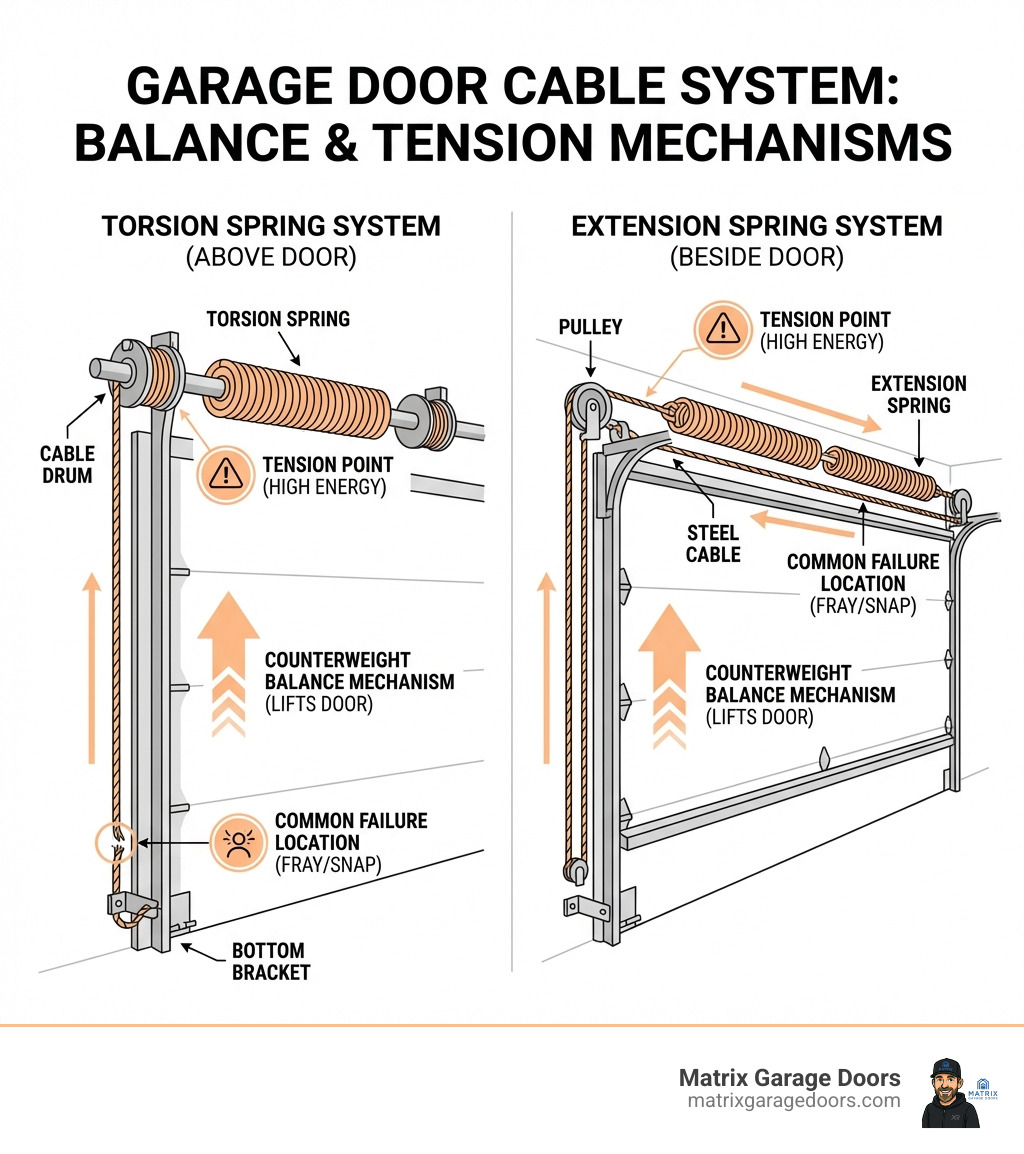
To understand how to replace garage door cable components, you first need to understand the relationship between cables and springs. Think of the springs as the “muscles” of the door and the cables as the “tendons.” The springs store mechanical energy, but they need the cables to transfer that energy to the bottom of the door to actually lift it.
Most homes in the Columbus area, from Westerville to Grove City, utilize one of two systems:
- Torsion Springs: These are mounted on a metal shaft directly above the garage door opening. As the door closes, the springs wind up, storing energy. When you open the door, they unwind, and the energy turns the shaft. This rotation spins the cable drums at each end, which wind up the steel aircraft cables and pull the door upward.
- Extension Springs: These are long, thin springs that run parallel to the horizontal tracks on both sides of the door. They stretch (extend) when the door is closed. They use a system of lifting pulleys and cables to counterbalance the weight. Because these springs can fly off with lethal force if they snap, they should always have a safety cable running through the center.
The cables themselves are typically made of galvanized steel aircraft cable, designed for high tensile strength and flexibility. They are attached to bottom brackets at the lower corners of the door. Because these brackets are under constant, extreme tension from the springs, they should never be unscrewed while the system is under load. For a deeper dive into the mechanics of a failure, check out the-ultimate-guide-to-fixing-a-snapped-garage-door-cable/.
Identifying a failing garage door often starts with looking at these cables. If the cable isn’t seated correctly in the drum or pulley, the door will never move straight.
Signs You Need to Replace Garage Door Cable
You don’t want to wait for a cable to snap while your car is halfway out of the garage. By performing a monthly visual inspection, you can spot the warning signs of a failing cable.
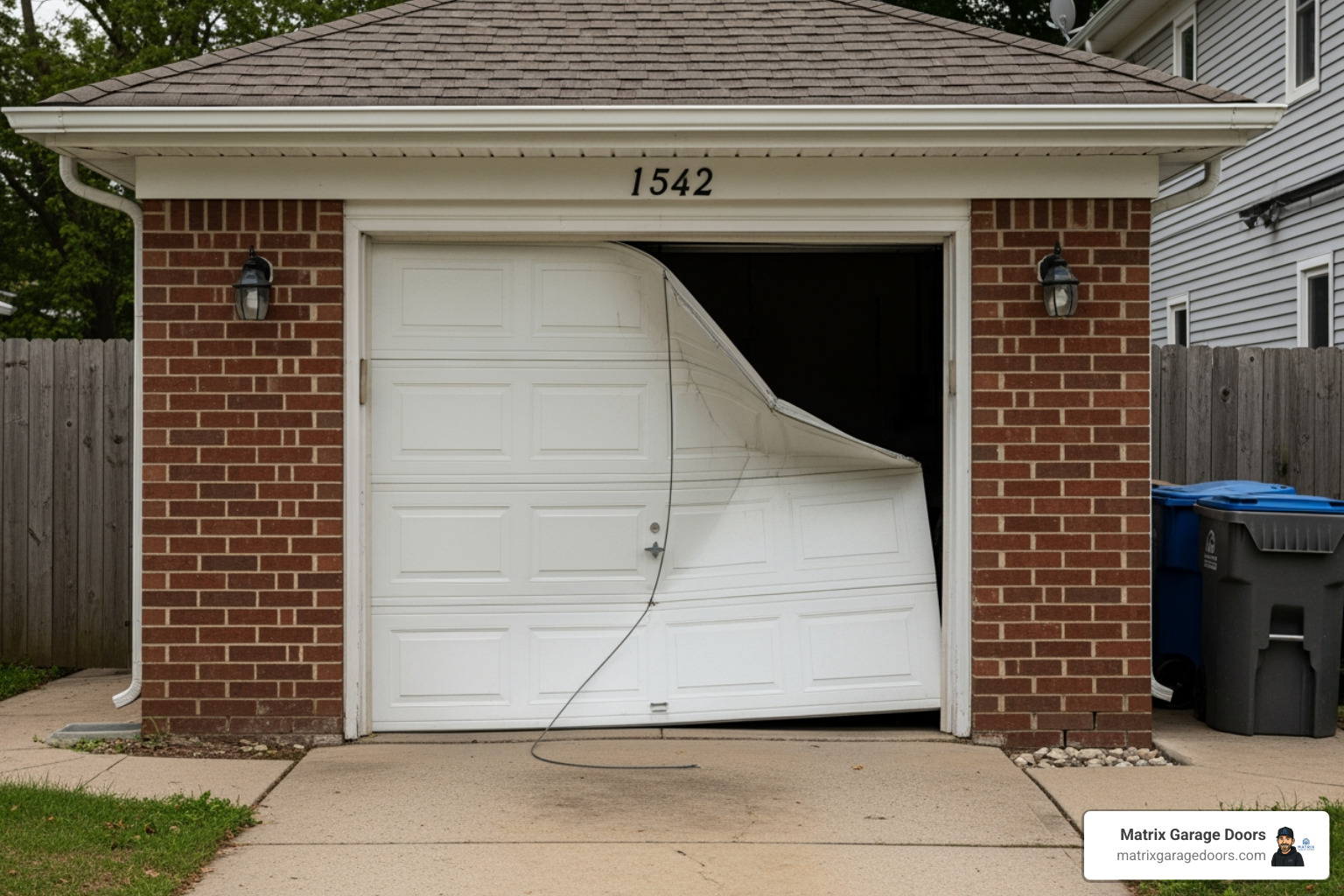
- Visual Fraying and “Shaggy” Wires: This is the most common early warning sign. Look for tiny individual wires sticking out from the main cable. If the cable looks “fuzzy” or shaggy, it means the structural integrity is compromised.
- Corrosion and Rust: In Ohio, our winters involve a lot of salt. If you notice rust on your cables, the metal is being eaten away. Brittle, rusty cables are prone to snapping without warning.
- Cable Slack: If you see the cable hanging loosely or sagging when the door is closed, the tension is off. This can cause the cable to slip off the drum, leading to a jammed door.
- Door Misalignment: If your door looks crooked or uneven when it’s moving or closed, one cable has likely stretched more than the other or has partially slipped.
- Grinding or Squeaking Noises: While many things cause noise, a cable that is rubbing against the track or a pulley that is seizing up will create distinct grinding sounds.
If you are seeing these signs, it’s time to look into decoding-garage-door-cable-repair-costs-a-comprehensive-guide/. Ignoring these symptoms often leads to the door getting stuck in the tracks, which can bend the rails and significantly increase your repair bill. You can find specialized Part/Components for sectional doors online, but ensure they match your door’s weight and height specifications.
Identifying Your System Before You Replace Garage Door Cable
Before you buy parts, you must know what system you have.
- Torsion System: Look for a thick bar (torsion shaft) above the door. If you see one or two large springs coiled around that bar, you have a torsion system. You will need to measure the spring wire thickness and the winding direction (often color-coded: red for left-wind, black for right-wind) if you are also replacing springs.
- Extension System: If you see springs hanging above the horizontal tracks (stretching toward the back of the garage), you have extension springs.
- Manuals: If you have a specific opener like a Chamberlain, referring to the Chamberlain HD420EV Handleiding can help you understand how the opener interacts with the cable system, though the cables themselves are part of the door hardware, not the motor.
Safety Precautions and Required Tools
We cannot stress this enough: garage door repair is dangerous. The springs are under enough tension to break bones or worse. If you decide to DIY, you must have the right tools—substitutions like using a screwdriver instead of a winding bar are how accidents happen.
Required Tools:
- Winding Bars: Specifically sized for your torsion cones.
- C-clamps or Locking Pliers (Vice-Grips): To secure the door in place.
- Socket Wrench Set: For the drum set screws and bottom brackets.
- Safety Glasses and Leather Gloves: To protect against snapping wires and metal shards.
Safety Rules:
- Never work alone: Have a partner who can call for help if something goes wrong.
- Disconnect the power: Ensure the automatic opener cannot activate while your hands are in the mechanism.
- Respect the Spring Energy: Before touching the cables, the spring tension must be fully released. If you are unsure how to do this, read our guide on fix-garage-door-spring-cable or garage-spring-fix/.
How to Safely Replace Garage Door Cable
The process differs slightly depending on your spring type, but the goal is the same: remove the old cable and install the new one while the system is “dead” (under no tension).
| Step | Torsion Spring System | Extension Spring System |
|---|---|---|
| 1. Secure Door | Clamp the door to the track so it cannot move. | Open the door fully and clamp under the bottom roller. |
| 2. Release Tension | Use winding bars to unwind the torsion spring. | Disconnect the spring from the pulley/rear hanger. |
| 3. Cable Removal | Loosen drum set screws and unhook from bottom bracket. | Unthread from pulleys and unhook from bottom bracket. |
| 4. Installation | Thread new cable through the drum and hook to bracket. | Thread through pulleys and hook to bracket. |
| 5. Re-tensioning | Wind the spring back to the required number of turns. | Reattach spring to the pulley system. |
Before starting, it is often helpful to review the steps for replace-garage-door-spring/ as these tasks are frequently performed together.
Step-by-Step Process to Replace Garage Door Cable
- Unplug the Opener: Ensure no one can accidentally trigger the door.
- Clamp the Tracks: Place C-clamps on the tracks above the rollers to prevent the door from moving. If the door is closed, clamp above the bottom rollers.
- Release Tension: For torsion springs, insert a winding bar into the winding cone, loosen the set screws, and carefully unwind the spring one quarter-turn at a time.
- Remove Old Cable: Once the tension is gone, the cable will be slack. Loosen the set screws on the cable drum. Unhook the cable from the bottom bracket peg.
- Install New Cable: Loop the new cable onto the bottom bracket peg. Thread it up to the drum.
- Wind the Drum: Insert the cable into the drum slot and wind it tightly into the grooves. Ensure there is no overlapping.
- Tighten and Tension: Tighten the drum set screws. Use your winding bars to put the tension back into the springs (usually 7.5 to 8 full turns for a 7-foot door).
- Test Balance: Remove the clamps. Lift the door halfway by hand. It should stay in place. If it falls or shoots up, the tension needs adjustment.
For more on the financial side of this process, see the cost-to-replace-springs-in-garage-door/.
Professional vs. DIY Repair Costs and Lifespan
When deciding whether to replace garage door cable yourself or hire us at Matrix Garage Doors, consider the value of your time and safety.
- DIY Costs: You can buy a pair of cables for $20–$50. However, if you don’t own winding bars ($30) or locking pliers ($20), your initial investment increases. Total DIY cost: $70–$120.
- Professional Costs: A standard cable replacement usually costs between $100 and $200 for parts and labor. If the springs also need replacement (which is common since they age together), the total is often $150–$350.
Lifespan and Cycles
Garage door components are rated by “cycles”—one opening and one closing. Most standard springs and cables last 10,000 to 20,000 cycles. For the average Columbus family using the door 4 times a day, this equals roughly 7 to 14 years. However, factors like the humid Ohio summers and freezing winters can cause metal fatigue earlier.
Professional service includes a warranty (usually 1–5 years on parts) and a full safety inspection. We often find that a “broken cable” is actually a symptom of a seized roller or a rusted bearing. Replacing just the cable without fixing the root cause will lead to another failure in months. Check out our garage-door-service-price-guide/ for more details. If you’re in a bind in Hilliard or Upper Arlington, we also offer emergency garage-door-repairs/.
Maintenance Tips to Prevent Cable Failure
You can extend the life of your cables by several years with just ten minutes of work every few months.
- Lubrication: Use a silicone-based lubricant on the cables, rollers, and springs. Avoid WD-40, as it is a degreaser, not a long-term lubricant. Lubricating the cables helps them glide over the drums without friction and prevents rust.
- Clean the Tracks: Dirt and grime in the tracks can cause the door to “stutter,” which puts sudden, jerky tension on the cables. Wipe the tracks down with a damp cloth.
- Annual Inspection: Look for fraying or rust. If you live in an area prone to moisture, like near the Hoover Reservoir in Westerville, check more frequently for salt air corrosion.
- Balance Test: Every six months, disconnect the opener and lift the door manually. It should feel light (under 10 pounds of force) and stay put when halfway open. An unbalanced door is the #1 killer of garage door cables and openers.
- Replace Both Cables: If one cable snaps, the other has just endured a massive shock load. Always replace them in pairs to ensure even tension and wear.
For more maintenance advice, see our garage-door-services/ page or our garage-door-service-prices-guide/.
Frequently Asked Questions about Garage Door Cables
Should I replace both cables at once if only one is damaged?
Yes, absolutely. Cables are usually installed at the same time and have undergone the same amount of wear and tear. If one has frayed to the point of breaking, the other is likely right behind it. Furthermore, new cables have slightly different elasticity than old ones; replacing only one can lead to an unbalanced door that pulls to one side.
What happens if I continue using a door with a frayed cable?
You are playing a dangerous game. A frayed cable can snap at any moment. If it snaps while the door is moving, the door can crash down, potentially crushing anything (or anyone) beneath it. It can also cause the door to jump out of the tracks, leading to much more expensive repairs involving the tracks, rollers, and the door panels themselves.
How do I know if my cable or my spring is the problem?
If the spring is broken, you will usually see a visible gap (2-3 inches) in the coils of the torsion spring, or the extension spring will be hanging limp. If the cable is the problem, you will see it hanging loose, frayed, or lying on the floor. If the door is heavy but the cables look tight, the spring has likely lost its tension.
Conclusion
Knowing when and how to replace garage door cable components is essential for any homeowner. While a DIY approach can save a few dollars, the safety risks associated with high-tension springs are significant. Whether you are in New Albany, Pickerington, or right here in Columbus, ensuring your garage door is balanced and safe is our top priority.
Matrix Garage Doors is a family-owned company in Columbus, OH, offering 24/7 emergency residential garage door repair, installation, and maintenance. With two decades of experience, we provide prompt, professional service for all garage door types, from standard sectional doors to custom wood models, guaranteeing customer satisfaction every time.
Don’t let a “shaggy” cable turn into a fallen door. Contact us for professional garage door services and repairs today, and let our expert technicians handle the heavy lifting safely.